Wednesday, April 13, 2011

Sandy Springs, Georgia: "The City that Outsourced Everything"

An interesting look at how a relatively new, but wealthier community (formed in 2005) has chosen to manage itself - outsourcing nearly all its services for substantial savings (from Reason.tv):


While cities across the country are cutting services, raising taxes and contemplating bankruptcy, something extraordinary is happening in a suburban community just north of Atlanta, Georgia.

Since incorporating in 2005, Sandy Springs has improved its services, invested tens of millions of dollars in infrastructure and kept taxes flat. And get this: Sandy Springs has no long-term liabilities.
It will be interesting to see how these new cities like this manage over time and the businesses and residents they attract. But it's exciting to see alternatives out there - and dare I say it, it's progressive, in the literal definition of the word.

Tuesday, April 12, 2011

Scott Adams: "Forget art history and calculus. Most students need to learn how to run a business"

I love business because they're often an exercise in creative problem solving, optimization wrapped in a bit (sometimes a lot) of psychology. It's too bad that academia too often sees ideas like profit and commerce as distasteful and a necessary evil. Scott Adams writes an opinion piece in the WSJ of the value of learning entrepreneurship:

I understand why the top students in America study physics, chemistry, calculus and classic literature. The kids in this brainy group are the future professors, scientists, thinkers and engineers who will propel civilization forward. But why do we make B students sit through these same classes? That's like trying to train your cat to do your taxes—a waste of time and money. Wouldn't it make more sense to teach B students something useful, like entrepreneurship?
More at his blog and/or the discussion at Hacker News.

Why We Aren't Running Out: "Prices are Incentives Wrapped in Knowledge"

A quick and good video on resources and why we haven't yet run out:

Monday, April 11, 2011

The Root of All Evil

The UK's Independent explores why the lack of empathy is the root of all evil:

Human cruelty has fascinated and puzzled Baron-Cohen since childhood. When he was seven years old, his father told him the Nazis had turned Jews into lampshades and soap. He also recounted the story of a woman he met who had her hands severed by Nazi doctors and sewn on opposite arms so the thumbs faced outwards. These images stuck in Simon's mind. He couldn't understand how one human could treat another with such cruelty. The explanation that the Nazis were simply evil didn't satisfy him. For Baron-Cohen, science provides a more satisfactory explanation for evil and that explanation is empathy – or rather, lack of empathy.

"Empathy is our ability to identify what someone else is thinking or feeling, and to respond to their thoughts and feelings with an appropriate emotion," writes Baron-Cohen. People who lack empathy see others as mere objects.

Empathy, like height, is a continuous variable, but for convenience, Baron-Cohen splits the continuum into six degrees – seven if you count zero empathy. Answering the empathy quotient (EQ) questionnaire, developed by Baron-Cohen and colleagues, will put you somewhere on the empathy bell curve. People with zero degrees of empathy will be at one end of the bell curve and those with six degrees of empathy at the other end.
Read the whole thing. I'd add though that this is probably one of the things that makes markets ingenious in co-opting the reward systems of "evil" for the benefits of society.

While malice, fraud, and other crimes exist, creating wealth legally within the system is far easier and more sustainable than the alternative. It's possible to profit if your motive is solely greed, but rewards are often greater when you aspire (or at least convincingly say you do) to more.

Sunday, April 10, 2011

Protect Nature: Put a price tag on it

A reminder that it's not money but the love of money that's the root of all evil. I'm sometimes dismissed as being entirely focused on money when the reality is that prices are only a way to evaluate tradeoffs and scarcity. By reducing things to abstract values, we may end up undervaluing them - and that's the case this article makes. From the Boston Globe:

In the United States, China, Costa Rica, and elsewhere, governments have opted to fund the preservation of forests, watersheds, and other ecosystems — and not because, or not only because, of their beauty. The primary impetus, rather, is the “services” they provide, including air and water purification, carbon sequestration, flood control, and drought prevention. The World Bank has sponsored numerous relevant projects, and a Stanford-based initiative, the Natural Capital Project, draws together environmental organizations and academics to advance and implement the idea.

And yet, for all of the obvious appeal of this approach to green types, there are serious concerns about translating ecological value into dollars and cents. Commodifying nature offends the sensibilities of some environmentalists, who believe we should prize it for its intrinsic worth, and for ethical and historical reasons. If we appraise nature only for the “services” it provides to humans, could that lead to an overly anthropocentric ethos that jettisons any elements that do not obviously accrue to our benefit?
Read the whole thing. More discussion at Hacker News.

Thursday, April 07, 2011

[How] Will Western Civilization Fall?

Stephan Balch at PJMedia asks "Is our civilization a bubble?" (via Instapundit). While there may be some cause for concern, there's greater cause for optimism:

For about the last two hundred years (three in a few locales), the fundamental structure of Western civilization has been anomalous in a crucial way. The anomaly consists in this: whereas in the overwhelming majority of societies the dominant route to wealth and status has been through political control, essentially the use of force or threat of force to extract value from others, in the West it has generally been through exchanges in which the parties have choices, and in which value must be returned for value received if the transaction is to consummate. We’re so conditioned to this, to the fact that our great fortunes belong to entrepreneurs, inventors, magnates, entertainers, and athletes, people who make (or do) things that others want, rather than to royalty, nobility, high priests, mandarins, court favorites and military leaders, people who take in taxes and booty things that others would prefer to keep, that we — very much including historians, journalists, and social commentators of almost every stripe — give little or no thought to it, considering it pretty much the natural order of things. But our exchange-oriented social order does not represent the natural order of things, and what it anomalously results in is of enormous –though perhaps ultimately self-destructive — consequence.
While popular academics like Jared Diamond fret over environmental catastrophes (Amazon), I think they underestimate the capacity of this system to adapt.

As Brink Lindsey points out in Against the Dead Hand (Amazon), it's a system that has come less from design than from default and accident - and it's one that can be undone.

Does this make our civilization a bubble? If this is question with respect to whether our civilization is unsustainable, I think the answer is an emphatic no. This also does not however mean that the anomaly cannot be undone through our "self destructive" tendencies - or as Lindsey calls it, the Dead Hand.

Wednesday, April 06, 2011

Urgh, Google Email Hacked.

If you're on my gmail address book, my apologies for the bit of spam.

Monday, April 04, 2011

When and How Prizes, Grants and Charity Work

I was hunting for something else online when I came across this talk by Tyler Cowen of Marginal Revolution, one of the top economics blogs online. A bit wonkish, but it talks to one of my favorite ideas and the efficient pursuit of big goals:


Related, from the organizers of some of some of my favorite races/prizes:

In memory of Cody, a border collie with spunk

With all that's been happening in the world, it feels weird and a bit callous to eulogize a dog. He was born February 6th, 2009, and died April 1st, 2011, of the canine distemper virus. He was adorable. I feel I had the privileges of a grandparent - I got all the benefits when I was there of having Cody, but few of the responsibilities. To him, I may have just been the guy who would leave for months at a time and bring back treats. But I always had treats.

Our reunions were always a bit of an oddity. He'd pounce up and then jump up and down so I'd play along and jump up and down with him while he'd bark until people looked at me funny - which, rest assuredly, was not very long, but perhaps somewhat alarmingly, a little longer than one might expect. He will be missed.


(And no, he did not die because he was strangled, but this was definitely a happier moment captured in low res)

Monday, March 28, 2011

Friday, March 25, 2011

Inbox Zero and Getting Things Done Humor

For your friends who follow GTD and Inbox Zero (via Unpluggd):

Wednesday, March 16, 2011

Sound of Music Flashmob at Antwerp

As some of you know, I have a soft spot in my dark cold space where there ought to be a heart, for good flash mobs:

Monday, March 14, 2011

Persistence and Success

Similar to the view that the easiest way to screw up your kids is to praise them for being smart rather than working hard (Parenting), Jonah Lehrer in Wired, notes what many of us (hopefully) already realize - success isn't easy, often isn't exciting, isn't the result of extraordinary intelligence but rather, extraordinary perseverance (Wired):

While [the growing recognition of “non-cognitive” skills like grit and self-control are] traits have little or nothing to do with intelligence (as measured by IQ scores), they often explain a larger share of individual variation when it comes to life success. It doesn’t matter if one is looking at retention rates at West Point or teacher performance within Teach for America or success in the spelling bee: Factors like grit are often the most predictive variables of real world performance. Thomas Edison was right: even genius is mostly just perspiration.

Taken together, these studies suggest that our most important talent is having a talent for working hard, for practicing even when practice isn’t fun. It’s about putting in the hours when we’d rather be watching TV, or drilling ourselves with notecards filled with obscure words instead of getting quizzed by a friend. Success is never easy. Talent requires grit.

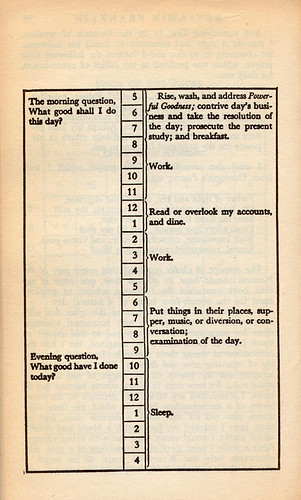
Benjamin Franklin's Daily Schedule

From one of the most productive people in American History (via Swiss Miss):

Benjamin Franklin's daily schedule

Sunday, March 13, 2011

Quote of the Day

Too true. From "Eliezer" on Hacker News:

World domination is such an ugly term. I prefer to call it world optimization.

Tuesday, March 08, 2011

A Sad Moment...

I heard about the assassination last week, but until it was brought to my attention by a friend, I didn't realize it had been a man I met (friend of a friend). I didn't know who Shahbaz Bhatti was at the time beyond being the Minister for Minorities in Pakistan, and the meeting itself was a bit rushed, but reading more I come to the realization that I met a great man and am reminded of what we take for granted (WashingtonPost):

American leverage in these matters is limited, but it is worth applying what we have - something the Obama administration, to this point, has not done. Its National Security Strategy avoids the topic. It did not appoint an ambassador at large for international religious freedom - a congressionally mandated position - until a year and a half after it took office. (The confirmation of that ambassador, by the way, is now held up by Republican Sen. Jim DeMint.) "This has not gotten," Clinton said at a recent hearing, "the level of attention and concern that it should. . . . I think we need to do much more to stand up for the rights of religious minorities."

This was precisely what Bhatti was doing - defending the rights of believers in every faith, not just his own. But the source of his courage in the cause of pluralism was clear: "These Taliban threaten me. But I want to share that I believe in Jesus Christ, who has given his own life for us. I know what is the meaning of [the] cross, and I am following the cross."

Which he followed all the way to the end.

Printing a Human Kidney

Another impressive TED talk (via Paul Kedrosky):

Monday, March 07, 2011

Cultural footnotes

Given that I love both Subway and McDonald's, this warms the cockles of my heart. There are no losers in this race. We're all winners for it. From the WSJ:

It's official: the Subway sandwich chain has surpassed McDonald's Corp. as the world's largest restaurant chain in terms of units.

At the end of last year, Subway had 33,749 restaurants world-wide, according to a Subway spokesman, compared to McDonald's 32,737. The burger giant disclosed its year-end store count in a Securities and Exchange Commission filing late last month.

Sunday, February 27, 2011

Ezra Levant: Asking all the uncomfortable questions

I think it says a bit about priorities that Europeans would criticize Canadian oil sands while ignoring the... let's call them "issues", with Libyan oil. Their supposed concern for the environment ranks higher than that of people. Ezra Levant:For Europe, Alberta oil is too dirty. Isn’t Libyan oil too bloody? (Toronto Sun via Instapundit):

Europe buys 80% of Libya’s oil. Other than terrorism, that’s pretty much the only thing Libya exports. . . . None of this is news. It’s olds. It’s been going on for years. What’s new is last week, the very week when Gadhafi and his son told the world they’d fight democracy protesters to the last bullet, was the week the European Union chose to criticize Canada’s oilsands because — get this — they say we have 20 more grams of carbon dioxide per megajoule of oil than Libya does.

It’s true, it takes more energy to produce oil from Canada’s oilsands than from Libya’s desert because we have to steam it out of the sand.

European oil imports from Iraq and Nigeria have the same carbon footprint as our oilsands. Those countries burn off the natural gas that comes up when they pump oil — an illegal environmental practice in Canada. And oil from Hugo Chavez’s Venezuela has even higher carbon emissions.
Update: The Mead List - World's Top 10 Gaddhafi Toads: #1 UN Human Rights Commission, #2 UK's Gordon Brown and his Government, #3 Hugo Chavez, #4 Nicholas Sarkozy, #5 Tony Blair.

Charlie Brooker vs. Colonel Gaddafi

I'm not sure what to think about this. On one hand I thought it was hysterical but the subtext is well... terribly sad and damning (h/t Jordie P on FB). I confess I have been listening to Muse's Uprising (YouTube) on repeat for the last few days.

Saturday, February 26, 2011

On Measuring Poverty

Daniel Hameresh from Freakonomics thinks that how we measure poverty reflects our attitudes towards it. I'd qualify that - it reflects the attitudes of the bureaucrats and elites towards poverty:

In the U.S., we define the poverty line as absolute: three times the income needed for a minimally nutritious food budget. In Europe, the poverty line is based on relative income, typically 50 percent of the median income.

This transatlantic difference says something about political/cultural differences. With our definition, in a growing economy, so long as inequality doesn’t increase too much and food prices don’t increase more than average prices, poverty will eventually disappear. We will not always have the poor with us in America. What an optimistic view — and what lack of concern about inequality! In Europe, even with income growth, unless inequality decreases, the fraction of households in poverty won’t change. How pessimistic, yet how concerned about equality!

A Photographer Reports from Libya

Some inspiring images from Libya (WSJ).

Thursday, February 24, 2011

Some People Just Don't Get It

It's as if they feel they're entitled to taxpayer dollars. An SEIU organizer (LookingattheLeft via Instapundit):

You’re an entrepreneur, so you don’t work."

Tuesday, February 22, 2011

The Moral Authority of the UN

I've never been a fan of realpolitik, but as Libyan warplanes and helicopters bomb protesters (Washington Post via Instapundit) - or as governments attack their own citizens elsewhere as they have in the Middle East like Egypt, it's difficult not to feel a little anger that the UN General Assembly voted to give Libya a seat on the Human Rights Council in 2010 (ForeignPolicy).

Monday, February 21, 2011

TED: Noreena Hertz on How to Use Experts -- and When Not To

Thought provoking talk about the problem of relying on experts on making important decisions by Noreena Hertz (TED.com) where apparently when we trust an expert, scans of brain activity show the level of our independent thought, flatlines.

Quote of the Day

While the most successful are often older, just by sheer numbers, fearlessness, and the falling need of capital to show a concept works - or even build an entire empire, fortune, is I think, increasingly favoring the young.

On why the young can often find great opportunities, from the WSJ (via Paul Kedrosky):

It's remarkable what you can achieve when you're too young to realize your limitations, or even to know that limitations exist.
[Subsequent thought... perhaps it's not so much that fortune is favoring the young, but equalizing the playing field for good ideas.]

Saturday, February 19, 2011

Niall Ferguson: How the West Won

(Or perhaps a more appropriate title would be How the West Got There First). Niall Ferguson, a historian's look at why the West developed so much faster than the rest of the world. He argues that it was for 6 primary reasons (Spectator via Paul Kedrosky):

  1. Competition: a decentralisation of political and economic life, which created the launch pad for both nation states and capitalism.

  2. Science: a way of understanding and ultimately changing the natural world, which gave the West (among other things) a major military advantage over the Rest.

  3. Property rights: the rule of law as a means of protecting private owners and peacefully resolving disputes between them, which formed the basis for the most stable form of representative government.

  4. Medicine: a branch of science that allowed a major improvement in health and life expectancy, beginning in Western societies, but also in their colonies.

  5. The consumer society: a mode of material living in which the production and purchase of clothing and other consumer goods play a central economic role, and without which the Industrial Revolution would have been unsustainable.

  6. The work ethic: a moral framework and mode of activity derivable from (among other sources) Protestant Christianity, which provides the glue for the dynamic and potentially unstable society created by the application of 1 to 5”

I think this explanation is more complicated than necessary as property rights and rule of law can spur such things as medicine and consumption while providing the incentives for a strong work ethic. I prefer Brink Lindsey's explanation.

"Fred's Five Rules for Product/Market Fit"

That'd be Fred Wilson, a VC @ Union Square Ventures, and a list that's built off his somewhat more meandering post here. They're a few ideas that have been occupying my mind lately - ideas that apply especially towards web startups. (h/t Paul Kedrosky):

  1. Early in a startup, product decisions should be hunch driven. Later on, product decisions should be data driven.

  2. Hunches come from being a power user of the products in your category and from having a long standing obsession about the problem you are solving.

  3. Domain expertise to the point of obsession is highly correlated with the most successful entrepeneurs in our portfolio.

  4. Ideas that most people derided as ridiculous have produced the best outcomes. Don't do the obvious thing.

  5. Monetization should be native and improve the experience for users.

Thursday, February 17, 2011

Why Technology Might make your Job Extinct and Why That's a Good Thing

The basic premise: the future is dynamic - and therefore jobs must be too. Technology not only destroys jobs but simultaneously creates more useful/productive opportunities. From Andy Kessler, a former hedge fund manager (WSJ):

Forget blue-collar and white- collar. There are two types of workers in our economy: creators and servers. Creators are the ones driving productivity—writing code, designing chips, creating drugs, running search engines. Servers, on the other hand, service these creators (and other servers) by building homes, providing food, offering legal advice, and working at the Department of Motor Vehicles. Many servers will be replaced by machines, by computers and by changes in how business operates. It's no coincidence that Google announced it plans to hire 6,000 workers in 2011. [...]

Like it or not, we are at the beginning of a decades-long trend. Beyond the demise of toll takers and stock traders, watch enrollment dwindle in law schools and medical schools. Watch the divergence in stock performance between companies that actually create and those that are in transition—just look at Apple, Netflix and Google over the last five years as compared to retailers and media.

But be warned that this economy is incredibly dynamic, and there is no quick fix for job creation when so much technology-driven job destruction is taking place. Fortunately, history shows that labor-saving machines haven't decreased overall employment even when they have made certain jobs obsolete. Ultimately the economic growth created by new jobs always overwhelms the drag from jobs destroyed—if policy makers let it happen.
Policymakers should take care that in implementing populist policies to "create jobs" that they aren't simply increasing the barriers and transitional costs of newer more sustainable jobs. The best way to do so is not to attempt to predict the future with directed spending/trade barriers/stimulus or subsidies, but to simply get out of the way.

Thomas Jefferson on Debt

Words of wisdom for nations and states around the world (Google Books via Instapundit/DailyPundit):

To preserve our independence, we must not let our rulers load us with perpetual debt. We must make our selection between economy and liberty or profusion and servitude.

If we run into such debts as that, we must be taxed in our meat and in our drink, in our necessaries and our comforts, in our labors and our amusements, for our callings and our creeds, as the people of England are.

Our people, like them, must come to labor sixteen hours in the twenty-four, give the earnings of fifteen of these to the government for their debts and daily expenses; and the sixteenth being insufficient to afford us bread, we must live, as they now do, on oatmeal and potatoes, have no time to think, no means of calling the mismanagers to account; but be glad to obtain subsistence by hiring ourselves to rivet their chains on the necks of our fellow-sufferers.

Our land-holders, too, like theirs, retaining, indeed, the title and stewardship of estates called theirs, but held really in trust for the treasury, must wander, like theirs, in foreign countries, and be contented with penury, obscurity, exile, and the glory of the nation.

This example reads to us the salutary lesson that private fortunes are destroyed by public, as well as by private extravagance. And this is the tendency of all human governments.

A departure from principle in one instance, becomes a precedent for a second, that second for a third, and so on, till the bulk of society is reduced to be mere automatons of misery, to have no sensibilities left but for sinning and suffering.

Then begins, indeed, the bellum omnium in omnia, which some philosophers, observing to be so general in the world, have mistaken it for the natural, instead of the abusive state of man.

And the forehorse of this frightful team is public debt. Taxation follows that, and in its train wretchedness and oppression.”

– Thomas Jefferson

Struggling for Time

As someone who has been keeping and archiving all their email, while struggling through David Allen's Getting Things Done (Amazon, also more here), this has been a helpful video helping me to rethink how I handle email - More on Merlin Mann's series here (43Folders):


(OK, granted, I haven't quite made it through all 60 minutes quite yet, but I'm getting there).

"When Robot Programmers get bored"

Awesome (h/t Tim W.):

Wednesday, February 16, 2011

Paper: Democracy, property rights, income equality, and corruption

Democracy, property rights, income equality, and corruption by Bin Dong and Benno Torgler via Economist Blog - from the abstract:

We establish a political economy model where the effect of democracy on corruption is conditional on income distribution and property rights protection. Our empirical analysis with cross-national panel data provides evidence that is consistent with the theoretical prediction. Moreover, the effect of democratization on corruption depends on the protection of property rights and income equality which shows that corruption is a nonlinear function of these variables. The results indicate that democracy will work better as a control of corruption if the property rights system works and there is a low level of income inequality. on the other hand if property rights are not secured and there is a strong income inequality, democracy may even lead to an increase of corruption. In addition, property rights protection and the mitigation of income inequality contribute in a strong manner to the reduction of corruption.
India is a country that comes to mind. Emphasizing the importance of strong property rights is often forgotten in the pursuit of democracy.

The Poor are Not Getting Poorer

(At least in the US) Simple and to the point (h/t Jeffrey Ellis):

Monday, February 07, 2011

"Development in 3 Sentences"

Am being creamed by another inordinate amount of procrastination coupled with actual work but this was too good not to post (The Coming Prosperity via Aidwatch):

If solutions are known, need $$. If solutions are knowable, need evaluations. If solutions are evolving, need entrepreneurs.

Friday, February 04, 2011

Skepticism, Hope and the Egyptian Revolution

While there have been a number of inspiring voices for liberty under the repressive regime of Mubarak. That something better will necessarily come out of this however, is far from certain given how organized the militants are and the likely influences of Iran. From Walter Russell Mead (read the whole thing):

On balance, the US administration has probably helped the government, and Washington’s intervention in the crisis is not (yet) turning out very well. Public pressure on President Mubarak to step down has allowed the Egyptian authorities to wrap themselves in the national flag. “Let’s find an Egyptian solution to Egypt’s problems,” they can say. “President Mubarak will not be running for re-election; do not let the Americans dictate our timetable for change.” Many in the Egyptian army who normally might have wanted to shed Mubarak quickly will now want to let him hang on through the fall to spite Obama if for no other reason. At the same time, foreign pressure gave the government an opening to crack down on foreign (and domestic) journalists, helping to deprive the revolution of the attention and television coverage vital to keeping public excitement and mobilization alive.

In revolution, momentum matters. In a poor country like Egypt, mass demonstrations cannot continue indefinitely. The middle class can stay in the streets, but the poorer people need to feed their families. A few days’ pay is all that stands between many families in Egypt and hunger. Beyond that, the kind of excitement that gives people the courage to defy authorities and risk death depends on an emotional surge that tends to fade as time drags on.

The Egyptian authorities needed to stall for time and slow down the clock. That they seem to have done; if they can hold the line, the regime (though not the Mubarak family) has a reasonable prospect of riding out the storm or of forcing a longer term stalemate.
And also from Jeffrey Miron:
But another component seems to be that the demonstrators want economic freedom, which is limited under the economic system in Egypt.

Milton Friedman’s view was that economic freedom is as important as political freedom: the right to vote in open elections is valuable, but so is the ability to run a business without oppressive regulation or earn an income without paying most of it in taxes.

A related point is that democracy does not necessarily produce economic development; rather, work by my colleagues Ed Glaeser and Andrei Shleifer suggests that better institutions, by themselves, do not systematically lead to economic growth. Rather, countries adopt better politicial institutions as their level of development progresses.

Friday, January 14, 2011

Quote: On the Urge to Save Humanity...

From a new group blog at the PJ Tatler: “The urge to save humanity is almost always a false-front for the urge to rule it.”

On balance I'd tend to agree, but there are new thought leaders like William Easterly and others who are pushing for change from the ground up and recognizing the power of commerce over subsidies and entitlements in the developing world and for those who seek a better life.

Wednesday, January 12, 2011

'It takes a civilization to build a toaster.'

A reminder courtesy of Thomas Thwaites of the manufacturing technology and ideas that go into producing simple as "simple" as a toaster - from scratch:

Friday, January 07, 2011

Another Quote

Yeah, yeah, I'll get to more substantive posts soon enough. Quips are so easy to post though (Clayton Cramer via The Thinker):

“The problem with Internet quotations is that many are not genuine.” - Abraham Lincoln

Thursday, January 06, 2011

Quote of the Day

Instapundit on the hunting and eating of invasive species:

I think when we message space aliens, the first question we should ask is, “Do you taste like chicken?”

Tuesday, January 04, 2011

Quote of the Day: Success at Writing (and Many Other Things...)

Found by a friend, Zoe L on Facebook:

Success at writing comes from 3% effort and 97% avoiding the internet.

Monday, January 03, 2011

Victor Davis Hanson: Raging Against "Them"

It it stupefying how out of touch some politicians and their constituents are when it comes to believing that jobs can be created by governments buying and regulating them into existence. Victor Davis Hanson captures this frustration perfectly (Pajamasmedia via Instapundit):

Oz is over with and the Greeks are furious at “them.” Furious in the sense that everyone must be blamed except themselves. So they protest and demonstrate that they do not wish to stop borrowing money to sustain a lifestyle that they have not earned—but do not wish to cut ties either with their EU beneficiaries and go it alone as in the 1970s. So they rage against reality.

The same is true of California. Our elites liked the idea of stopping new gas and oil extraction, shutting down the nuclear power industry, freezing state east-west freeways, strangling the mining and timber industries, cutting off water to agriculture in the Central Valley, diverting revenues from fixing roads and bridges to redistributive entitlements, and praising the new multicultural state that would welcome in half the nation’s 11-15 million illegal aliens. Better yet, the red-state-minded “they” (the nasty upper one-percent who stole from the rest of us due to their grasping but superfluous businesses) began to leave at the rate of 3,000 a week, ensuring the state a Senator Barbara Boxer into her nineties.
Read the whole thing.

Saturday, January 01, 2011

Unanticipated Hiatus & Ideas to Watch

The last few months have been transitional. I'd apologize for taking an unannounced break from blogging, but it happens. There's a lot of pent up blogging that I want to do time permitting but I've also taken on a few new large projects as I pivot with changing responsibilities at the company that I have been building over the past several years.

As I continue to get my bearings, check out think tank/marketing firm JWT's 100 Things to Watch in 2011 (Slidewatch via Paul Kedrosky):

Monday, November 01, 2010

Cute T-Mobile Flash Mob @ Heathrow

H/T Brian J (fb). While I enjoyed this, I confess if I were in the middle of it, I suspect I'd probably be that one surly impatient guy just trying to get out of there - I can only imagine the level of coordination that had to have gone into this:

Change to Believe In

Heh, a sign from Saturday's rally. From Greg Mankiw's Blog:

Saturday, October 30, 2010

Heh. A Bit of Historical Perspective on Attack Ads

You can be pretty certain that anyone who frets about how attack ads are nasty or that politics is divisive - at least when it comes to the American politics has little historical context or engaging in demagoguery. From Reason.com:

Thursday, October 28, 2010

Another take on China's "Currency Manipulation"

Argues John Cochrane, a professor of finance at the University of Chicago Booth School of Business, in the WSJ - "The Chinese government's accumulation of U.S. debt represents a tragic investment decision, not a currency-manipulation effort":

What's the right policy toward China? They put a few trillion dollars worth of stuff on boats and sent it to us in exchange for U.S. government bonds. Those bonds lost a lot of value when the dollar fell relative to the euro and other currencies. Then they put more stuff on boats and took in ever more dubious debt in exchange. We're in the process of devaluing again. The Chinese government's accumulation of U.S. debt represents a tragic investment decision, not a currency-manipulation effort. The right policy is flowers and chocolates, or at least a polite thank-you note.

Yet Mr. Geithner thinks that the Chinese somehow hurt us. There is at work here a strange marriage of Keynesianism and mercantilism—the view that U.S. consumers supported the world economy by spending beyond our means, so that other people could have the pleasure of sending things in exchange for pieces of paper.

This is all as fuzzy as it seems. Markets and exchange rates are not always right. But it is a pipe dream that busybodies at the IMF can find "imbalances," properly diagnose "overvalued" exchange rates, then "coordinate" structural, fiscal and exchange rate policies to "facilitate an orderly rebalancing of global demand," especially using "medium-term targets" rather than concrete actions. The German economics minister, Rainer Brüderle, called this "planned economy thinking." He was being generous. Planners have a clearer idea of what they are doing.

Zinger of the Day

Katie Couric is quoted as calling middle America "This Great Unwashed Middle of the Country"

Jim Treacher, a conservative commentator retorts, noting her plummeting ratings (the Daily Caller), calls her the "the great unwatched".

Wednesday, October 27, 2010

A Fight to Watch

I've never really understood California. For as much as you get the beach bum 'live and let live' type vibe when you're there and for all the technological innovation being churned out in silicon valley, the people seem to consistently elect politicians who have this affinity for unions, regulations and bigger government.

Here's how TechCrunch describes a potentially disruptive business under attack:

Last week San Francisco car matching startup UberCab was served a cease and desist order by the city of San Francisco because it did not have taxi licenses or taxi insurance and went beyond the normal scope of a limo service by picking people up right away.

As UberCab (which has now changed its name to Uber) serves primarily tech industry elite, there is much Internet debate over whether this is another case of “Innovation vs. Establishment” or a startup just straight up breaking the law.
Michael Arrington inked an editorial that noted out "The outpouring of support from the community will be huge. And given that this model has potential to shake up the industry is all the major metropolitan areas across the country, there’s going to be a ton of interest in this case from all around. And UberCab will bathe in free publicity."

I can't help but love fights like this. As it turns out, the publicity has been very helpful to Uber (peHUB):
“Given the cease-and-desist [orders], it’s been a busy week,” laughs Kalanick. “We’ve seen waves of social media interest. We were a trending topic on Twitter. It’s business as usual at this point, but with a lot more attention and activity.”

It’s great news for a company that right now has plans to move into new markets, including New York and Los Angeles, and will undoubtedly be facing knockoffs if it doesn’t hustle.

Friday, October 22, 2010

US Healthcare and Unintended Consequences

An employer cuts healthcare coverage for employees in anticipation of the healthcare reform act (BusinessInsider):

When they wrote this year’s legislation, policymakers had a choice: They could emphasize near-universal coverage, or they could emphasize controlling costs. They opted for near-universal coverage. As a result, business owners and higher income Americans (many of whom, like me, are one and the same) will soon pay an array of higher taxes to finance the broader coverage that President Obama and congressional Democrats mandated.

So I now find myself responsible for paying for health insurance for more than 30 million strangers. Yet the cash needs of my business, which is growing despite the difficult economy of the past few years, are not going to decline. Nor are my personal financial commitments going to decrease. The only way to make financial room for those 30 million strangers is to stop paying for insurance for the 20 people I work with every day.

Politics mandated that Obama and his fellow Democrats at least pretend that their legislation will constrain runaway spending. The new law’s very name is part of that pretense. But there is little in the actual legislation that has any real prospect of controlling spending; instead, the law attempts to control premiums by fiat through new regulations and oversight. Government may be able to prevent insurers from pricing policies in ways that make sense, but it can’t force them to operate at a loss. The other shoe, in the form of higher premium prices or a rollback of the new law’s mandates, is certain to drop. Higher prices are the more likely outcome. [...]

The law’s supporters will portray employers like me as bad guys who are using the new law as a smokescreen to make changes we wanted to make anyway. Though the accusation is false, it has a germ of truth: Runaway health insurance costs have been a burden for every business that pays them. Every sensible manager has at least considered steps to stem this financial hemorrhage. Many of us were just holding on so as not to disrupt employees’ lives while we waited for policymakers to do something.

Now they have done something, and it only made the problem worse. There is no longer any reason to wait.
Read the whole thing.

Thursday, October 21, 2010

On Working Hard

Catarina Fake (Swiss Miss via Lifehacker):

Working on the right thing is probably more important than working hard.

On Electing the Right People

via Instapundit quoting Milton Friedman:

People have a great misconception in this way they think the way you solve things is by electing the right people. It's nice to elect the right people but that isn't the way you solve things. The way you solve things is by making it politically profitable for the wrong people to do the right thing.

Wednesday, October 20, 2010

Sustainable US Stimulus on the Cheap

The CEO of Cisco and President of Oracle present an interesting solution developmentin a WSJ OpEd:

One trillion dollars is roughly the amount of earnings that American companies have in their foreign operations—and that they could repatriate to the United States. That money, in turn, could be invested in U.S. jobs, capital assets, research and development, and more.

But for U.S companies such repatriation of earnings carries a significant penalty: a federal tax of up to 35%. This means that U.S. companies can, without significant consequence, use their foreign earnings to invest in any country in the world—except here. [...]

By permitting companies to repatriate foreign earnings at a low tax rate—say, 5%—Congress and the president could create a privately funded stimulus of up to a trillion dollars. They could also raise up to $50 billion in federal tax revenue. That's money the economy would not otherwise receive.
The upside is that the investments made by these companies would almost certainly be invested more efficiently and on more sustainable businesses than the US government spends. The downside, is exposure to the demagoguery of activists who decry supposed tax breaks for the rich and corporations. More cynically, what Chambers and Katz haven't quite considered, is that if it's companies who invest and repatriate money then politicians no longer have the control - and to date, that's seemed to be an influential consideration in stimulus spending. If only we lived in a more rational world...

Home Brew Biotech Capitalists

More on that theme that capitalism doesn't require nearly as much capital anymore. It turns out that the cost of doing biotech is falling - in some cases dramatically to the point that it's possible to do research in your bedroom/basement (naturenews):

Carlson penned essays and articles that fanned the embers of the idea. "The era of garage biology is upon us," he wrote in a 2005 article in the technology magazine Wired. "Want to participate?" The democratization of science, he reasoned, would bring in new talent to build and improve scientific instrumentation, and maybe help to uncover new industrial applications for biotechnology. Eventually, he decided to follow his own advice, setting up a garage lab in 2005. "I made the prediction," he says, "so I figured maybe I should do the experiment."

Carlson is not alone. Would-be 'biohackers' around the world are setting up labs in their garages, closets and kitchens — from professional scientists keeping a side project at home to individuals who have never used a pipette before. They buy used lab equipment online, convert webcams into US$10 microscopes and incubate tubes of genetically engineered Escherichia coli in their armpits. (It's cheaper than shelling out $100 or more on a 37 °C incubator.) Some share protocols and ideas in open forums. Others prefer to keep their labs under wraps, concerned that authorities will take one look at the gear in their garages and label them as bioterrorists. [...]

Still, five years after taking science into his garage, Carlson says he's convinced that biohacking has the potential to trigger a technological revolution. "We're going to see a lot more at the garage level that will produce a variety of products in the marketplace, one way or another," he says.
Despite the discomfort of thinking that your neighbours next door could be brewing anthrax, that's always been the risk. They could be making fertilizer bombs now for all I know but the potential rewards and potential breakthroughs are substantial as more amateurs consider new ways to solve real problems - and that's the essence of markets and capitalism.

Monday, October 18, 2010

Where the jobs are

From Rich Lowry, National Review:

Texas already looms large in its own imagination. Its elevated self-image didn’t need this: More than half of the net new jobs in the U.S. during the past 12 months were created in the Lone Star State.

According to the Bureau of Labor Statistics, 214,000 net new jobs were created in the United States from August 2009 to August 2010. Texas created 119,000 jobs during the same period. If every state in the country had performed as well, we’d have created about 1.5 million jobs nationally during the past year, and maybe “stimulus” wouldn’t be such a dirty word.

What does Austin know that Washington doesn’t? At its simplest: Don’t overtax and -spend, keep regulations to a minimum, avoid letting unions and trial lawyers run riot, and display an enormous neon sign saying, “Open for Business.”
More (10/20): Here (WILLisms) with a comparison to California.

The Sustainability and the Efficacy of Charity

From Bloomberg (via Jeffrey Ellis):

“The only way to fight poverty is with employment,” [Carlos] Slim [, the richest man in the world] said at a conference in Sydney last month. “Trillions of dollars have been given to charity in the last 50 years, and they don’t solve anything.”
As previously noted, it's important to differentiate between relief and economic development - but otherwise Carlos Slim (despite how he came into wealth and has protected it) is right.

Economist Andy Xie: It's time for China to pop the bubble

I know I haven't done as much China blogging lately. To be honest, I'm not sure what to make of things. A lot has been happening. Protectionism is creeping up which ironically has benefited us since we developed alternative manufacturing sources through Asia as a contingency plan. China continues to grow while the rest of the world stagnates - and that has created resentment - but I suspect China's growth is uncertain at best. Capital is deployed inefficiently and creating bubbles in China. From economist Andy Xie (China International Business):

Profit drives investment, which in turn powers employment, and that then grows consumption. When profit is due to asset appreciation and not sustainable, it may lead to crisis. Large bubbles often occur during prolonged prosperity, when people stop paying attention to risk and there is excessive demand for risky assets, leading to an asset bubble that prolongs prosperity beyond the normal cycle.

Possibly half of China's bank lending is going into property-related businesses or local governments that are pledging land as collateral. While the current boom has catapulted China ahead of Japan to become the world's second-largest economy, we must remember the excesses in this cycle and the need for an adjustment as soon as possible. Nothing reveals the vulnerabilities more than the banking system's exposure to unsustainable economic activities that are dependent on land appreciation. China should proactively bring about the needed economic adjustment.
For more thoughts, economist and outside observer Michael Pettis considers what China's alternatives are, and what will happen as the RMB is forced to revalue.

Tuesday, October 12, 2010

What Motivates Us: The Importance of Purpose

Paulus pointed me to this vid (Thanks!). The key takeaway:

For simple straightforward tasks ... the carrot and stick approach to motivation is outstanding [...] When a task gets more complicated, requiring some conceptual, creative thinking, those types of incentives demonstrably don't work.
What works? Connecting work to purpose. Organizations get in trouble when there is a disconnect between the profit motive and purpose. Definitely worth 10 minutes of your time if you spend any amount of time thinking about these things.

On Perseverance and Determination

The Atlantic takes a look at the inventor for the Supersoaker's other development that apparently could make solar power cheap - and I'm a sucker for a good entrepreneurial story. The inventor, Lonnie Johnson, has a quote hanging above his desk attributed to Calvin Coolidge worth noting:

Nothing in the world can take the place of persistence. Talent will not; nothing is more common than unsuccessful men with talent. Genius will not; unrewarded genius is almost a proverb. Education alone will not; the world is full of educated derelicts. Persistence and determination alone are omnipotent.

Affirmative Action: Market Edition

It pays to hire women in countries that won't according to new research from Harvard Business School:

For multinational firms, the opportunity seems obvious: If you operate in a sexist country full of educated, experienced women with expertise on their home country, then it makes sense to hire those women into management roles. "You can tap into their underutilized talent and benefit from their insights," Siegel says.
I'm pretty sure this type of thing applies to all groups that are discriminated against. Markets favor merit, create incentives and positive feedback loops. Government imposed regulations and policies? Not so much.

Monday, October 11, 2010

At least the French do have a Sense of Humor?

Brandon who linked this calls the ad "brilliant". I'd have to agree - particularly if you've watched the March of the Penguins / The Emperor's Journey (imdb):

Of Consumers, Capitalism and Capitalists

Jeffrey Ellis at The Thinker points to Horwitz's First Law of Political Economy: "No one hates capitalism more than capitalists" but makes note of its corollary -

"No one loves capitalism more than consumers." Because consumers are the ones who benefit the most from free markets and competition.
Truer words...

Sunday, October 10, 2010

Pretending to be Rich

A few notes from the co-author of The Millionaire Next Door and author of new book Stop Acting Rich: ...And Start Living Like A Real Millionaire (Amazon.com) in the Washington Post:

  • Eighty-six percent of all prestige or luxury makes of motor vehicles are driven by people who are not millionaires.
  • Typically, millionaires pay about $16 (including tip) for a haircut.
  • Nearly four in 10 millionaires buy wine that costs about $10.
  • In the United States, there are nearly three times as many millionaires living in homes with a market value of less than $300,000 than there are living in homes valued at $1 million or more.
  • Forget the Manolo Blahnik high-priced shoes. The No. 1 shoe brand worn by millionaire women is Nine West. Their favorite clothing store is Ann Taylor.
I think too many of us have been spending too much with borrowed money particularly in the US and Canada. That being said, these are personal choices we all make, and the lessons we learn while far from ideal, are healthy ones. With choices come consequences, and unfortunately I doubt we've truly dealt with the full aftermath. Not sure that I think things are this dire but follow on thoughts here from James Quinn @ FinancialSense (via Instapundit).

A Cautionary Note on Soaking the Rich

From Greg Mankiw (NYTimes):

Maybe you are looking forward to a particular actor’s next movie or a particular novelist’s next book. Perhaps you wish that your favorite singer would have a concert near where you live. Or, someday, you may need treatment from a highly trained surgeon, or your child may need braces from the local orthodontist. Like me, these individuals respond to incentives. (Indeed, some studies report that high-income taxpayers are particularly responsive to taxes.) As they face higher tax rates, their services will be in shorter supply.

Reasonable people can disagree about whether and how much the government should redistribute income. And, to be sure, the looming budget deficits require hard choices about spending and taxes. But don’t let anyone fool you into thinking that when the government taxes the rich, only the rich bear the burden.
An interesting discussion at HN that questions the validity of a few of his assumptions. There are two basic issues I have with most of the criticism - the first is this assumption that taxed revenues are being redeployed in something useful other than feeding ever larger bureaucracies that provide a net benefit to overall society and the second, if we understand high income earners (not to be confused with the wealthiest) to be the most economically productive in society, should there be any surprise if the productivity of society falls as these individuals choose not to work as much or as hard?

Remembering Che Guevera

As he should be remembered (Townhall via Powerlineblog):

"When you saw the beaming look on Che's face as the victims were tied to the stake and blasted apart by the firing squad," said a former Cuban political prisoner Roberto Martin-Perez, to your humble servant here, "you saw there was something seriously, seriously wrong with Che Guevara." As commander of the La Cabana execution yard, Che often shattered the skull of the condemned man (or boy) by firing the coup de grace himself. When other duties tore him away from his beloved execution yard, he consoled himself by viewing the slaughter. Che's second-story office in Havana's La Cabana prison had a section of wall torn out so he could watch his darling firing-squads at work.

Even as a youth, Ernesto Guevara's writings revealed a serious mental illness. "My nostrils dilate while savoring the acrid odor of gunpowder and blood. Crazy with fury I will stain my rifle red while slaughtering any vencido that falls in my hands!" This passage is from Ernesto Guevara's famous Motorcycle Diaries, though Robert Redford somehow overlooked it while directing his heart-warming movie. ...

The one genuine accomplishment in Che Guevara's life was the mass-murder of defenseless men and boys. Under his own gun dozens died. Under his orders thousands crumpled. At everything else Che Guevara failed abysmally, even comically.
Previous notes on the man here.

More Giggles...

For quick pick me upppers, I saw these two commercials recently and wanted to share:


As the escapistmagazine says on this one, "this parody wins the internet" (Thanks Tom!):

Friday, October 08, 2010

Giggle of the Day

Fox News via The Thinker: Postal Union Election Delayed After Ballots Lost in the Mail

Fear Not, Keepers of a Messy Desk?

Not that I need any further disincentive to keep my desk organized. Mom, take note - quote from a short film "The Desk" posted at core77:

Einstein's desk was famously messy so he stood as an example of a person who could be extremely efficient and extremely creative but at the same time very very messy. People with messy desks tend to be more open to new experiences, and [it] reflects their mental process.

"The Desk" from Benjamin Cox on Vimeo.

Wednesday, October 06, 2010

Thought of the Day: Takers and Makers

From Fred Wilson, a venture capitalist:

There are takers and makers in this world. Takers make their money by taking from others. They are usually bad business people and their careers often end in failure. Makers build things. They create value for society, their employees, their shareholders, and themselves.
Not entirely sure if I believe "takers" usually get their comeuppance, but I do believe that the upside in life is far greater for "makers" than "takers".

Tuesday, October 05, 2010

Even more honest?

I should note that I have a friend who is an avid environmentalist and a 'warmist' who is absolutely appalled by the original video. While I'd argue it's a logical conclusion based on the arguments that many environmentalists make, this is probably the best parody of the original (Warning - it's graphic, via DailyCaller):


Says the Daily Caller:
Tim Blair says it best. The producers’ message is: “If you aren’t a warmist, you deserve to become a warm mist.”
Update Oct 6: More fantasies of people killing children (Hotair)

Monday, October 04, 2010

Of the Web, Startups and Facebook

I saw The Social Network (imdb) with Anthony Del Col (Kill Shakespeare) on Friday. It was surprisingly entertaining, but also a bit empty. Like Anthony, I can't say I really empathized with the characters, and while I confess I felt like a bit of an underachiever afterwards, it was also quite motivating.

I don't always agree with Lawrence Lessig but he makes a useful observation on why Facebook is different than great startups of the past. It truly has never been a better time to be alive if you're an entrepreneur (The New Republic):

For comparison’s sake, consider another pair of Massachusetts entrepreneurs, Tom First and Tom Scott. After graduating from Brown in 1989, they started a delivery service to boats on Nantucket Sound. During their first winter, they invented a juice drink. People liked their juice. Slowly, it dawned on First and Scott that maybe there was a business here. Nantucket Nectars was born. The two Toms started the long slog of getting distribution. Ocean Spray bought the company. It later sold the business to Cadbury Schweppes.

At each step after the first, along the way to giving their customers what they wanted, the two Toms had to ask permission from someone. They needed permission from a manufacturer to get into his plant. Permission from a distributor to get into her network. And permission from stores to get before the customer. Each step between the idea and the customer was a slog. They made the slog, and succeeded. But many try to make that slog and fail. Sometimes for good reasons. Sometimes not.

Zuckerberg faced no such barrier. For less than $1,000, he could get his idea onto the Internet. He needed no permission from the network provider. He needed no clearance from Harvard to offer it to Harvard students. Neither with Yale, or Princeton, or Stanford. Nor with every other community he invited in. Because the platform of the Internet is open and free, or in the language of the day, because it is a “neutral network,” a billion Mark Zuckerbergs have the opportunity to invent for the platform. And though there are crucial partners who are essential to bring the product to market, the cost of proving viability on this platform has dropped dramatically. You don’t even have to possess Zuckerberg’s technical genius to develop your own idea for the Internet today. Websites across the developing world deliver high quality coding to complement the very best ideas from anywhere.

Saturday, October 02, 2010

At Least They're Being Honest....?

Watch this. Keep in mind it's not a parody. (Simon Jester via Instapundit)


A tempered response here (WindyPundit). Also a muted apology from the organization (1010global.org).

Not Coming to Air Canada Any Time Soon

via Tim:

Thursday, September 30, 2010

Quote of the Day

Vinod Khosla, one of the world’s leading clean tech investors, at the TechCrunch Disrupt conference (TechCrunch):

Environmentalists get in the way…and do more damage than they know
TechCrunch goes on to explain:
Self-described environmentalists demand or adopt technology that sounds promising without a sense of its true cost or impact to the environment. “Painting your roof white is better for the environment than driving a Prius or similar vehicle,” Khosla pointed out.

Tuesday, September 28, 2010

Quote of the Day

Friedrich Hayek, The Fatal Conceit (via Greg Mankiw): "The curious task of economics is to demonstrate to men how little they really know about what they imagine they can design."

Monday, September 27, 2010

Simon Sinek: Start with Why

Simon Sinek: "We follow those who lead not for them but for ourselves. It is those who start with 'why' that have the ability to inspire those around them or find others who inspire them." Another interesting thought was that people should be hired not for what they do, but why they do it. Another book to add to my ever flowing list of books to read. In the meantime, watch his TED presentation here (via Swissmiss):

A Warning for "Smart" People

"Stupid people think you are as stupid as they are." It's sometimes a bit difficult to tell if you're the stupid one in the equation. Colorful anecdote here (kikabink.com).

Thursday, September 23, 2010

More from Steven Johnson: "Chance favors the connected mind"

I guess they're bringing out the PR wagon for the upcoming book launch, and based on this presentation and the TED presentation, it looks like it'll be a very worthwhile read:


More @ the WSJ: The Genius of the Tinkerer.

TED.com: Steven Johnson - Where Good Ideas Come From

An interesting talk from Steven Johnson (based on his coming book, Amazon) exploring how and where we come up with good ideas:

Saturday, September 18, 2010

PSA: Love may be hazardous to your friendships

I may be immune to this disorder but for those who are prone to suffering from it - "falling in love comes at the cost of losing two close friends, a study says" (BBC):

"People who are in romantic relationships - instead of having the typical five [individuals] on average, they only have four in that circle," explained Robin Dunbar, a professor of evolutionary anthropology at Oxford.

"And bearing in mind that one of those is the new person that's come into your life, it means you've had to give up two others."

Friday, September 17, 2010

What Passes as "Cool"

Something to forward to those who wear Mao or Che Guevera logos - from recently examined Chinese archives (The Independent via Ann Althouse, em mine):

At least 45 million people were worked, starved or beaten to death in China over these four years; the worldwide death toll of the Second World War was 55 million. [...] Between 1958 and 1962, a war raged between the peasants and the state; it was a period when a third of all homes in China were destroyed to produce fertiliser and when the nation descended into famine and starvation, Mr Dikötter said.

For those who committed any acts of disobedience, however minor, the punishments were huge. State retribution for tiny thefts, such as stealing a potato, even by a child, would include being tied up and thrown into a pond; parents were forced to bury their children alive or were doused in excrement and urine, others were set alight, or had a nose or ear cut off. One record shows how a man was branded with hot metal. People were forced to work naked in the middle of winter; 80 per cent of all the villagers in one region of a quarter of a million Chinese were banned from the official canteen because they were too old or ill to be effective workers, so were deliberately starved to death.
In the face of this evidence, what defies imagination is that there are those who blame colonial powers for China's poverty, saying they robbed China of its resources prior to Mao's ascendence.

Saturday, September 11, 2010

"Surprise!" Exactly What You'd Expect to Happen

For similar reasons that I'm skeptical that gold will remain being a useful/safe peg of value, there are supposedly smart people from the dawn of time who believe that they can manipulate or corner the market on XYZ commodities (and the corollary of politicians who flame fears of shortage).

Needed in everything from electronics to small motors, "rare earth metals" are only the most recent scare that China has restricted exports for domestic production needs (The Australian). While it's true that in the short term resources are finite, in the long run, they're only limited by human ingenuity. And as Forbes is reporting, so it's true here - Japanese companies (and I'm sure others around the world) are responding to high prices to generate alternatives:

With prices spiking following the latest in a series of annual export quota reductions by Beijing earlier this summer, miners have been scrambling to develop deposits of the essential industrial minerals worldwide. Now Japan’s Nikkei business daily reports that Japanese manufacturers have developed technologies to make automotive and home appliance motors without rare earth metals. Hitachi has come up with a motor that uses a ferrite magnet made of the cheaper and more common ferric oxide. Meanwhile the chemicals conglomerate Teijin and Tohoku University have co-developed technology to make a powerful magnet using a new composite made of iron and nitrogen.
Take another step back and you also see the remarkable power that pricing communicates to the market. While the reactionary political response invariably is to further restrict and regulate trade, it would be refreshing if the opposite were pursued - that measures to innovate and unleash innovation to find additional or create alternative resources were pursued. Alas, dare to dream.

More on that topic of gold (Sept 13, BusinessInsider): Reasons that gold is a religion masquerading as an asset Class.

Friday, September 10, 2010

A Politician to Like...


From Roger Kimball (Pajamasmedia):
Christie didn’t “lambaste” teachers, he said, he lambasted the teacher’s union, especially its leaders. Why were so many teachers laid off in New Jersey? Because when the Governor called upon teachers to take one-year pay freeze and contribute 1.5% — one-and a half percent! — of their salaries to the cost of their health care (full-family medical, dental, and vision coverage, by the way), the union leaders said “No way. Not a penny.” Result: nearly a billion-dollar shortfall in the budget, which necessitated scads of lay offs. (Had Gov. Christie’s proposal been accepted, the state would have saved more than $700,000,000.) “So who’s really to blame?” he asked: the Governor or the intransigent teachers unions?

Thursday, September 09, 2010

Pursuing Job Security

Scott Adams, the cartoonist of Dilbert, has a few thoughts on skills that can help make you more marketable as an employee (Dilbert):

I think technical people, and engineers in particular, will always have good job prospects. But what if you don't have the aptitude or personality to follow a technical path? How do you prepare for the future?

I'd like to see a college major focusing on the various skills of human persuasion. That's the sort of skillset that the marketplace will always value and the Internet is unlikely to replace.
Not sure if I agree about all his specific ideas but I think the basic premise is a sound one - taken one step further, it's businesses that maximize the potential of its people who are most sustainable. And it's difficult to do that without managers and staff who have those skill sets. Read the whole thing.

Fidel: 'Cuban Model Doesn't Even Work For Us Anymore'

Wow (The Atlantic). Of course, this presumes it ever did...?

Maslow's Hierarchy of Needs and Confirmation Bias?

Something to explore later when I have more time, but is Megan McArdle saying that Maslow's Hierarchy of Needs was developed to fit his view of the world rather than his observations of it? From a passage she quotes on her blog [emphasis mine] (the Atlantic):

Maslow admired many people I admire, Abraham Lincoln for example. But he and I can't admire Lincoln through some objective lens as psychologists or scientists. We can only say we admire Lincoln with the same level of objectivity that someone else might admire Jefferson Davis. Maslow wanted to give an objective validation that, for example, the Viet Nam war protestor was objectively superior to the Viet Nam general, the environmentalist was objectively superior to the captain of industry etc. Many cultural elites ate it up, just as Soviet elites ate it up when their psychiatrists said that anyone who didn't love the government was mentally ill and needed electroshock treatment post-haste.

Psychologists and social scientists generally still venture repeatedly today into the territory of human values and attempt to claim the ability to make objective judgments about which are the most healthy or scientifically validated. They don't ever seem to learn that they are often just trying to rationalize cultural fashions: In the 1940s the "mentally healthy" person was one who respected tradition, but he morphed into the to-be-pitied "organization man" in the 1950s. Psychologists valorized divorce as the "mentally healthy choice" for those who were not "growing" in the 1970s, whereas today they tend to say that it's better to stick it out and stop complaining so much.
Over the years, I've heard that the Hierarchy of Needs wasn't evidence based nor had there been much corroborating research but this is the first time I've heard how it was developed. Definitely something to explore further.

Sounds about right to me...

Not sure about the original points he was trying to make since there is an element of uncertainty in the whole sausage making process of regulations and pork barreling but... (Forbes):

For the time being, we’re in a vicious cycle. Consumers won’t step up their spending until unemployment eases, which won’t happen until consumers step up their spending enough to make it profitable for companies to hire additional employees.

Over the long run, though, the economy will perform better and unemployment will be lower if we reduce the drag of taxes and regulations that can’t be justified by tangible benefits. That’s the story business leaders should make if they want to help themselves and allow Adam Smith’s Invisible Hand to help the country
The fact that the BBC is reporting that the US has been overtaken by Sweden, Switzerland and Singapore in the World Economic Forum competitiveness survey should only underscore this point.

Wednesday, September 08, 2010

More on School Choice

via Fred Wilson - "I saw this film last night. It made me angry and upset. Go see it. It will be in the theaters on Sept 24th.":


It would seem that the movie has been getting a lot of press. More here (NYMag):
For decades, the conversation about our schools has been the preserve of the education Establishment—and the result has been a system that, with few exceptions, runs the gamut from mediocre to calamitous. Waiting for “Superman” is no manifesto. It offers no quick fixes, no easy to-do lists, no incandescent lightbulbs to unscrew. What it offers is a picture of our schools that isn’t pretty, but that we need to apprehend if we’re to summon the political will necessary to transform them. “Nobody ever wants to call a baby ugly,” says Duncan. “This is like calling the baby ugly. It’s about confronting brutal truths.”

Monday, September 06, 2010

Relationship "Best Practices": Four Minutes in the Morning

It takes a special kind of someone to use the words "best practice" and marriage or relationship in the same sentence. Not that I have any expertise in the area - quite the opposite really, this showed up on one of the VC blogs I follow, from Brad Feld:

Amy and I created a tradition about a decade ago we call “four minutes in the morning.” We try to – fully clothed – spend four minutes together every morning 100% focused on each other. [...] Of course, the “four minutes” is metaphorical. Sometimes it’s 15 minutes. A few times a year it turns into an hour when we end up in a discussion about something. But it’s always 100% bi-directional attention, except for our dogs who often want in on the discussion.
Seems like a good idea, makes sense and something to try (if I'm ever lucky enough to find myself in that situation).