Monday, August 29, 2011

The Canadian Government's Guide to the United States

While a lot of us joke that what makes us Canadian is a near universal belief that "we're not American", this presumably unintentionally hilarious guide put out by the Canadian Foreign Affairs Department helps to guide us on how best to interact with Americans so as not to make them feel uncomfortable (via Carson):

In the US, much like in Canada, the personal bubble seems to range between 2 to 3 feet with closer allowances for louder places (such as a night-club or sporting event). In this context, you will usually get closer to allow yourself to be heard and then back away while reaffirming what you just said with the corresponding facial expression.
In a more intimate setting, the space bubble will decrease. In general, you don’t want to be "in someone’s face". 
Eye contact is good as long as it is not confrontational (don’t stare). It usually denotes interest and understanding. It is good to nod your head in agreement occasionally to show you are engaged in the conversation. 
As in Canada, people are not very tactile at first encounter. There is of course the customary handshake when you meet (right hand only, not too strong), and when you leave. In a social setting, when you don’t know people very well, a smile and wave will usually do. If you really hit it off with someone, you may graduate to the hug and kiss on both cheeks. This is not the norm in a business setting. 
In business, you will always want to a firm handshake; look the person in the eye while doing so. If someone shakes your hand without letting go, you can apply slight pressure with your other hand to their shaking arm’s elbow, holding the elbow lightly. This seems to work as a subtle cue to "let go".

Sunday, August 28, 2011

Hayek on Keynes

via AdamSmith.org - a look back for a bit of historical perspective and ideological rigidity that is now ascribed to Keynes but perhaps should not be:

Friday, August 26, 2011

A Four Minute History of Economics

With gems such as these: "1866... Labour's share of income is rising. Karl Marx's own income puts him in the top 2% of British households. 1867 - Das Kapital goes to press without Karl Marx ever visiting a factory." via Greg Mankiw.


Steve Jobs: America's Greatest Failure?

A bit of a reminder of why I've been a bit of an America-phile (NationalReview):

Steve Jobs’s announcement that he is stepping down as CEO of Apple is not surprising. He’s a very sick man; and running the world’s largest market-cap technology firm can’t be easy for someone with pancreatic cancer and who-knows-what other ailments.

Lots of digital ink will be spilled about Jobs in the coming days, most of it focusing on his truly marvelous successes.

It’s better to focus on his failures.

Jobs failed better than anyone else in Silicon Valley, maybe better than anyone in corporate America. By that I mean Jobs did what only the greatest entrepreneurs can do: learn from their failures. I don’t mean learn from their mistakes. I mean learn from their abject, humiliating, bonehead, epic fails.

Everyone today thinks of Jobs as the genius who gave us the iPod, MacBooks, the iTunes store, the iPhone, the iPad, and so on. Yes, he transformed personal computing and multimedia. But let’s not forget what else Jobs did.  
The genius of the US isn't so much that it celebrates its successes, but rather it does not shame and perhaps in part, celebrates its failures. In so doing, encourages more attempts. Read the whole thing.

Thursday, August 25, 2011

Heh. Too true.

DSCN1096

Wednesday, August 24, 2011

Some truths should be self evident...

Here's Marco Rubio, junior Senator from Florida speaking at the Reagan Library. While I can't say I understand or agree with his stance on some social issues, here are two comments from the speech that stood out (via NationalReview):

  • "The free enterprise system has lifted more people out of poverty than all the government anti-poverty programs combined"
  • “Poverty does not create our social problems; our social problems create our poverty."

Monday, August 22, 2011

The Predictable “Catastrophe” of the Dodd-Frank Conflict Mineral Provision

David Aronson in the New York Times via Freakonomics:

Unfortunately, the Dodd-Frank law has had unintended and devastating consequences, as I saw firsthand on a trip to eastern Congo this summer. The law has brought about a de facto embargo on the minerals mined in the region, including tin, tungsten and the tantalum that is essential for making cellphones.

The smelting companies that used to buy from eastern Congo have stopped. No one wants to be tarred with financing African warlords — especially the glamorous high-tech firms like Apple and Intel that are often the ultimate buyers of these minerals. It’s easier to sidestep Congo than to sort out the complexities of Congolese politics — especially when minerals are readily available from other, safer countries.

For locals, however, the law has been a catastrophe. In South Kivu Province, I heard from scores of artisanal miners and small-scale purchasers, who used to make a few dollars a day digging ore out of mountainsides with hand tools. Paltry as it may seem, this income was a lifeline for people in a region that was devastated by 32 years of misrule under the kleptocracy of Mobutu Sese Seko (when the country was known as Zaire) and that is now just beginning to emerge from over a decade of brutal war and internal strife.
As Daniel Hamermesh @ Freakonomics notes, "Brownback’s provision has harmed precisely those it was designed to protect, the small-scale miners in the Congo, but it has certainly lowered the price faced by Chinese processors for these inputs. Law of unintended, but what should have been perfectly expected, consequences."

More on Aid and Haiti

Felix Salmon who I find somewhat inconsistent in his views of the role of state versus that of markets, writes a pretty damning overview of aid and Haiti in the aftermath of the earthquake (Reuters):

What happens when you drop billions of dollars onto a country like Haiti? Immediately after the earthquake happened, in January 2010, I said that “one of the lessons we’ve learned from trying to rebuild failed states elsewhere in the world is that throwing money at the issue is very likely to backfire”. But that’s exactly what we did — with predictable results.
I’d urge you to read Janet Reitman’s full 12,000-word Rolling Stone article on what an enormous amount of foreign aid has done for Haiti; it’s a wonderful piece of journalism, albeit a very depressing one.
The first thing to note is that most of the money given to Haiti hasn’t even started to be spent yet: a whopping $11 billion was pledged by donor countries and financial institutions in the wake of the earthquake, but if you take the US as a good example, it’s so far managed to spend just $184 million of the $1.14 billion allocated to the country. Even the Red Cross is barely halfway into its $479 million fund — all of which has been earmarked for Haiti, and none of which can be spent elsewhere, no matter how much better it might be put to use in some other context. 
But even the amount of money that has been spent has been harmful in its own way. Haiti has been known as “the Republic of NGOs” for well over a decade now, but the earthquake just turbocharged their presence while devastating everything else, leaving foreign aid the only game in town
More here.

Sunday, August 14, 2011

QOTD: On Conspiracy Theories...

Because I have a number of friends who are conspiracy nuts - you know who you are ;). Steve Jobs via Paul Kedrosky:

“When you’re young, you look at television and think, There’s a conspiracy. The networks have conspired to dumb us down. But when you get a little older, you realize that’s not true. The networks are in business to give people exactly what they want. That’s a far more depressing thought. Conspiracy is optimistic! You can shoot the bastards! We can have a revolution! But the networks are really in business to give people what they want. It’s the truth.”
Though I don't really consider it depressing given that what we demand is getting better all the time. Not to mention the vapid, mainstream media continues to lose its grip as gatekeepers of the news and continue to hemorrhage viewers to those who seek more comprehensive sources like the net.

Friday, August 12, 2011

More on "Made in China"

From Fortune:

And despite what you may conclude from shopping at Wal-Mart (WMT) or other large stores -- or hearing big, scary figures about the trade deficit with China -- imports from China make up just a very small portion of our total economy: just 2.5% of gross domestic product in 2010. Overall, products from around the world accounted for only 16% of our GDP last year. "The vast majority of goods and services sold in the United States is produced here," according to FRBSF report authors Galina Hale and Bart Hobijn. The exceptions are furniture and household items, electronic goods, and clothing and shoes. A third of U.S. consumer purchases for clothing and shoes in 2010 carried a "Made in China" label. For furniture, it was one fifth.

Tuesday, August 09, 2011

Politics & Wealth: Can you get rich without democracy?

Dani Rodrik via theEconomist:


Yes if you are an individual, but probably not if you are an entire country. As the figure below shows, there are very few countries that have developed beyond $5,000 in 2005 PPP dollars without becoming democracies somewhere along the way (unless they are an oil economy).

A Perfect Logo for Government & Innovation

via Beata / Michelle Malkin:


[The propaganda for the launch of the blog and logo for it:]
It made for one fine sound bite. But it hasn’t exactly inspired a bunch of innovation rallies and bake sales. So in the spirit of banging the drum for new ideas and fresh thinking, this blog will track all things innovative, not just in science and technology, but also in how we live, how we learn, how we entertain ourselves.
“Check out the logo. 3 interlocking gears arranged in this fashion will not move in any direction. They are essentially locked in place. Which when you think about it, is a perfect analogy of today’s government!”

Monday, August 08, 2011

Made in China? Apparently not so much...?

From Paul Kedrosky:

Thus, on average, of every dollar spent on an item labeled “Made in China,” 55 cents go for services produced in the United States. In other words, the U.S. content of “Made in China” is about 55%.

Thought of the Day: On Anger

Jeffrey Ellis from TheThinkerBlog:

Anger causes us to lose our empathy, our ability to relate to others and see things from their viewpoint [...] human evil is the result of an erosion or lack of empathy [...] Anger is an emotion that enables humans to be evil.

Friday, August 05, 2011

The "Live Aid" Legacy

Just a reminder that good intentions really aren't enough (from the blog of the same name) and a look back at the disturbing legacy of Live Aid and how it ended up being a step back:

Starving children with flies around their eyes
80% of the British public strongly associate the developing world with doom-laden images of famine, disaster and Western aid. Sixteen years on from Live Aid, these images are still top of mind and maintain a powerful grip on the British psyche.

Victims are seen as less than human
Stereotypes of deprivation and poverty, together with images of Western aid, can lead to an impression that people in the developing world are helpless victims. 74% of the British public believe that these countries “depend on the money and knowledge of the West to progress.”

False sense of superiority and inferiority
The danger of stereotypes of this depth and magnitude is the psychological relationship they create between the developed and the developing world, which revolves around an implicit sense of superiority and inferiority.

Powerful giver and grateful receiver
The Live Aid Legacy defines the roles in our relationship with the developing world. We are powerful, benevolent givers; they are grateful receivers. There is no recognition that we in Britain may have something to gain from the relationship.

Confidence in out-of-date knowledge
Researchers remarked on the respondents’ confidence in such one-dimensional images. British consumers are not hesitating or seeking reassurance for their views. Unconsciously accumulated images of the developing world have led to a certainty on the part of consumers that they have all the facts.

Wednesday, July 20, 2011

Quote of the Day

Winston Churchill (themellowjihadi.com via Instapundit):

The inherent vice of capitalism is the unequal sharing of blessings; the inherent virtue of socialism is the equal sharing of miseries.
Of course, "socialism"/central planning in the real world generally translates into the worst of both.

Monday, July 18, 2011

Nathan Myhrvold: Cooking as never seen before

Pretty darn cool via TED.com.

Thursday, July 14, 2011

Ben Pieratt: Why graphic designers (and more broadly, just about anyone) should work for a Startup

Ben Pieratt via Swissmiss:

The internet, at this time in history, is the greatest client assignment of all time. The Western world is porting itself over to the web in mind and deed and is looking to make itself comfortable and productive. It’s every person in the world, connected to every other person in the world, and no one fully understands how to make best use of this new reality because no one has seen anything like it before. The internet wants to hire you to build stuff for it because its trying to figure out what it can do. It’s offering you a blank check and asking you to come up with something fascinating and useful that it can embrace en masse, to the benefit of everyone.

Monday, July 11, 2011

The Gell-Mann Amnesia effect

Michael Crichton (via Paul Kedrosky):

Briefly stated, the Gell-Mann Amnesia effect is as follows. You open the newspaper to an article on some subject you know well. In Murray's case, physics. In mine, show business. You read the article and see the journalist has absolutely no understanding of either the facts or the issues. Often, the article is so wrong it actually presents the story backward—reversing cause and effect. I call these the "wet streets cause rain" stories. Paper's full of them.

In any case, you read with exasperation or amusement the multiple errors in a story, and then turn the page to national or international affairs, and read as if the rest of the newspaper was somehow more accurate about Palestine than the baloney you just read. You turn the page, and forget what you know.

Thursday, July 07, 2011

Tim Worstall on Trade

In his Forbes column, I think Worstall makes two important points in rejecting some of the arguments for encroaching protectionism:

1. "There are, for example, only 30 production jobs inside the US associated with the iPod manufacture. [...] the majority of the wages paid as a result of the iPod are inside the US. Even while a minority of the jobs aren’t the US, the majority of the wages are: meaning that whatever is being done in the US is obviously and clearly higher paid than the manufacturing which isn’t being done in the US. It is true that in the past manufacturing jobs in the US were highly paid. But now manufacturing jobs are low paid, as we can see from these figures. So the call to bring back those “high wage manufacturing jobs” to the US doesn’t work: there aren’t any high wage manufacturing jobs to take anywhere."

2. "We shouldn’t be worrying about the jobs of the producers, their wages nor profits, in fact, anything else about the producers at all. We’re talking economics here, the allocation of scarce resources so as to satisfy the maximum amount possible of human desires and wants. Which means attending to the consumer, the ability of the consumer to consume, nothing else."
More on the debate here (Economist).

Wednesday, July 06, 2011

Are Not For Profits More Virtuous? No.

In many ways, quite the opposite. From Arnold Kling (via Beata):

I think that profit-seeking enterprises serve the community, also. In fact, they do it in a way that is more sustainable and more accountable. It is more sustainable, in that the value of what they produce is greater than the cost of the resources (including labor) that they use. Otherwise, they would not make a profit. However, a non-profit can very well use more resources than the value of what it produces. A profit-seeking enterprise is more accountable, in that a profit-seeking business must satisfy consumers or else go out of business. Hence, it must provide something of value to its customers. On the other hand, if a non-profit fails to provide any benefit to its customers, it still might be able to obtain grants from the government or from donors.
More here (Arnold Kling).

Monday, June 20, 2011

Robert Heinlein: Poverty is the normal condition of man

We know enough about poverty and development to know the broader policies that work, but more importantly the many that do not. As Glenn Reynolds points out, this is a dictum worth repeating (Instapundit):

Throughout history, poverty is the normal condition of man. Advances which permit this norm to be exceeded — here and there, now and then — are the work of an extremely small minority, frequently despised, often condemned, and almost always opposed by all right-thinking people. Whenever this tiny minority is kept from creating, or (as sometimes happens) is driven out of a society, the people then slip back into abject poverty.

This is known as “bad luck.”

Friday, June 17, 2011

A definition of "work" to strive for

Response to question from the SwissMiss by iconic Swiss Designer Jost Hochuli:

Swissmiss: “What’s your definition of work?”
Jost Hochuli: “70% pleasure!”

Paul Graham: Ignore Competition, Focus on Improving Lives

I suspect there's a bit of a selection bias (in that he's only ever invested in one company that was ultimately killed off by a larger competitor), but it's a point that I agree with and a video worth watching: YouTube (Video embed on this disabled - 14 minutes).

Tuesday, June 14, 2011

Bjorn Lomborg: Our lifestyle is unsustainable but that's irrelevant

An interesting read - Lomborg argues we consistently underestimate our capacity to innovate (Newsweek via Instapundit):

Climate alarmists and campaigning environmentalists argue that the industrialized countries of the world have made sizable withdrawals on nature’s fixed allowance, and unless we change our ways, and soon, we are doomed to an abrupt end. Take the recent proclamation from the United Nations Environment Program, which argued that governments should dramatically cut back on the use of resources. The mantra has become commonplace: our current way of living is selfish and unsustainable. We are wrecking the world. We are gobbling up the last resources. We are cutting down the rainforest. We are polluting the water. We are polluting the air. We are killing plants and animals, destroying the ozone layer, burning the world through our addiction to fossil fuels, and leaving a devastated planet for future generations.

In other words, humanity is doomed.

It is a compelling story, no doubt. It is also fundamentally wrong, and the consequences are severe. Tragically, exaggerated environmental worries—and the willingness of so many to believe them—could ultimately prevent us from finding smarter ways to actually help our planet and ensure the health of the environment for future generations.

Because, our fears notwithstanding, we actually get smarter. Although Westerners were once reliant on whale oil for lighting, we never actually ran out of whales. Why? High demand and rising prices for whale oil spurred a search for and investment in the 19th-century version of alternative energy. First, kerosene from petroleum replaced whale oil. We didn’t run out of kerosene, either: electricity supplanted it because it was a superior way to light our planet.

For generations, we have consistently underestimated our capacity for innovation. There was a time when we worried that all of London would be covered with horse manure because of the increasing use of horse-drawn carriages. Thanks to the invention of the car, London has 7 million inhabitants today. Dung disaster averted.

Monday, June 13, 2011

On Inspiration and Just Getting Things Done

via swissmiss, Chuck Close:

Inspiration is for amateurs; the rest of us just show up and get to work.

Sunday, June 12, 2011

On the enlightenment of organic farming

From a comment on SmallDeadAnimals:

One German organic farm has killed twice as many people as the Fukushima nuclear disaster and the Gulf Oil spill combined.
Time to invoke the precautionary principle? (Washington Times via SmallDeadAnimals)

Friday, June 10, 2011

On the lightbulb ban

Yep, pretty much (Virginia Postrel @Bloomberg via Instapundit):

The bulb ban makes sense only one of two ways: either as an expression of cultural sanctimony, with a little technophilia thrown in for added glamour, or as a roundabout way to transfer wealth from the general public to the few businesses with the know-how to produce the light bulbs consumers don’t really want to buy.

Foreign Aid in Haiti: Oops

I didn't plan this juxtaposition - but this highlights the difference between aid and commerce. The lack of development is not from the lack of resources.

For private firms, the money runs out and they try something different, charities, not-for-profits often don't have similar constraints - or are at least not bound to the same level of accountability and often do the same things. What's worse is that the impact of botched aid are so much worse than failed firms. One aid practitioner in Haiti argues it's time to give up and after 200 years of attempted assistance, Haiti is a "massive debacle" (TakesfromtheHood via Beata):

I think it’s time for Aid to leave Haiti.

I’ve certainly defended Aid enough on this blog, including different things about the earthquake response in Haiti. In this case, though, I see the earthquake response in Haiti as simply the icing on the cake. Many have said that Haiti was a disaster before the earthquake, and I’d agree. What is said less often, is that Aid also was broken in Haiti before the earthquake. Depending on which numbers you crunch, and how you crunch them, Haiti is only incrementally worse off now than it was on January 9, 2010. I do not say this to in any way compliment the combined, inter-agency relief response, but rather to highlight just how bad things were pre-earthquake, despite decades of foreign assistance. It’s time to call this what it is: a massive debacle.

I honestly think that the very best thing for Haiti would be for us all to leave. I do not (yet) believe that Aid is broken globally. But it is certainly broken in Haiti. I sincerely believe that in the grand scheme of things we are not doing Haiti any real favors by staying on. We need to get out. All of us. All of the foreign governments with their incentives and their politicians who visit and make speeches about “Haiti’s bright future.” All of the UN and INGOs with their massive compounds and their VHF radios and their strategies. All of the hippy architects with their houses made out of recycled trash, the BOGO entrepreneurs with their GIK dumping, the bright-eyed innovators with their “platforms” and their earth-friendly gadgets. For heavens’ sake, all of the church groups with their matching T-shirts and their pet orphanages.
I should note that having worked in development, I recognize how difficult this conclusion is. It's advocating effectively abandoning friends and people who you have struggled to help. It's also recognizing what a failure your time has been in building something sustainable. But it is doing so in hopes of something better.

Groupon in China: Oops

Remarkable - am sure this would make a great textbook case study of what not to do at some point. No idea what they were thinking, but I have to imagine they have some amazing offices (TechCrunch):

This all matters greatly for potential investors, because as the S1 showed, much of Groupon’s warchest of venture capital has gone to its aggressive international expansion. As we reported last week, Groupon’s U.S operations lost only $10.4 million last year, whereas the international operations lost $170.6 million.

Much of that has gone to China. Five days after Groupon’s January near-$1 billion venture round was raised, a job board advertising Groupon positions in China boasted “near endless” resources from that round to build out the office. Reading that ad and looking at how Groupon has done in China, one could argue not all that money was, shall we say, judiciously spent. A more blunt way of putting it would be Groupon’s China team made drunken sailors look fiscally responsible.

Despite Mason’s blithe statements to the contrary on stage at All Things D, China is not going well for Groupon. In fact, by all accounts, Groupon has made every classic Silicon-Valley-Web-company-enters-China mistake in the book: Sparring with its local partners, putting foreigners who have little understanding of the local market in charge, and focusing hiring on bankers and international MBAs, not locals.

Wednesday, June 08, 2011

TED: Redefining Success, Finding Happiness

A thoughtful (and witty) TED Talk by Alain de Botton who points out among many other things, that our increasingly egalitarian society means that we're also more likely to be envious of others (via swissmiss):

Tuesday, June 07, 2011

(Unintended?) Consequences...

A study in what happens when you have a government and bureaucrats brazenly and opportunistically take over private assets for personal gain - How to Steal a Russian Airport (NYT):

In truth, as long as the plutocrats thumb their noses at the rule of law and steal corporate assets with impunity, no Russian company is going to get the price their assets may deserve. That’s the real market condition. It won’t change until the practice ends.

For that to happen, though, the plutocrats would have to start caring about their country — and not just themselves.
Meanwhile in related news - The Washington Post factchecks President Obama's speech on the auto industry bailout (via Instapundit).

Monday, June 06, 2011

World Bank: Economic Freedom, Civil & Political Liberties Cause Better Economies

Color me not shocked. From a study at the World Bank Dan Mitchell (via Instapundit):

Reviewing the economic performance—good and bad—of more than 100 countries over the past 30 years, this paper finds new empirical evidence supporting the idea that economic freedom and civil and political liberties are the root causes of why some countries achieve and sustain better economic outcomes. For instance, a one unit change in the initial level of economic freedom between two countries (on a scale of 1 to 10) is associated with an almost 1 percentage point differential in their average long-run economic growth rates. In the case of civil and political liberties, the long-term effect is also positive and significant with a differential of 0.3 percentage point. In addition to the initial conditions, the expansion of freedom conditions over time (economic, civil, and political) also positively influences long-run economic growth. In contrast, no evidence was found that the initial level of entitlement rights or their change over time had any significant effects on long-term per capita income, except for a negative effect in some specifications of the model. These results tend to support earlier findings that beyond core functions of government responsibility—including the protection of liberty itself—the expansion of the state to provide for various entitlements, including so-called economic, social, and cultural rights, may not make people richer in the long run and may even make them poorer.

Sunday, June 05, 2011

Contrasts in courage

For those who may have not have seen the story of the 21-year old parliamentary page who, following the recent federal election where the Harper government achieved a majority government, decided to stand up with a sign that said "Stop Harper" and called for an "Arab Spring", a contrast in courage (Terry Glavin via SmallDeadAnimals):

Brigette DePape: The 21-year-old graduate from the University of Ottawa made headlines for holding up a protest sign that read 'Stop Harper' at the start of the Throne Speech: "This country needs a Canadian version of an Arab Spring." DePape has since received several job offers and is considering taking a position with the Public Service Alliance of Canada.

Hamza Ali al-Khateeb: A 13-year-old Syrian boy who tagged along at an antigovernment protest in the town of Saida a few weeks ago, was arrested, was burned, beaten, lacerated and given electroshocks. His jaw and kneecaps were shattered. He was shot in both arms. When his father saw the state of Hamza’s body, he passed out.
Yes, because a Canadian Conservative government is exactly like the Syrian dictatorship. In a way I hope that DePaper gets hired by PSAC (a union) - as the precedent has been set - though by the very job offer I wonder if it has been set already and that in the coming years PSAC will get everything they deserve. Perhaps in a truly just world DePape would be exported to protest in a similar way in Syria though I don't think I would be so cruel.

Friday, June 03, 2011

Taking the Capital out of Capitalism

Technology is making prices and value more transparent allowing for the development of new business models that rent out excess capacity, and as a corollary, making the need for capital less important than it was before (WSJ):

A second wave of online rental sites is catching fire with consumers and investors, with start-ups like spare-room market Airbnb Inc., textbook lender Chegg Inc. and fashion outfit Rent the Runway following the success of pioneers like Netflix Inc. and Zipcar Inc.

While many of the companies took off during the frugal days of the recession, they are continuing to do well in a climate where consumers remain cautious about paying full price for things they don't need or want to own.
More on how the web is bringing liquidity and transparency to previously illiquid assets (TechCrunch).

Monday, May 30, 2011

Happy employees make for more profitable companies

The virtuous cycle of markets strikes again (BarkingUpTheWrongTree):

The results indicate that employee work perceptions predict important organizational outcomes -- if employees have positive perceptions of their jobs, their organizations benefit via higher employee retention, increased customer loyalty, and improved financial outcomes. Interestingly, the analysis suggests that employee perceptions affect outcomes more than outcomes affect employee perceptions of their jobs.

The #1 Impediment to Development and Growth?

A reminder that it's government (TechCrunch):

It’s ironic that Ethiopia’s current government are the same people who overthrew the brutal Marxists called the Derg twenty years ago; alas, they seem to have inherited some of their archenemies’ fondness for monopolies, protectionism, and bureaucracy. I believe mobile Internet access is a transformational force that could turn African nations into economic lions to rival Asia’s tigers—but only if it’s fast, cheap, and ubiquitous. And that will never happen here while every bit of Ethiopia’s Internet is controlled by a dinosaur monopoly with no competitive incentive to improve.

Friday, May 27, 2011

Rosabeth Moss Kanter: The Four Things the Internet Doesn't Change

I found this list to be useful - how the internet changes everything except these four things (HBR):

1. A great customer experience differentiates winners from losers.
2. The human side is critical to the use of technology.
3. Money needs to change hands.
4. Government and business still talk past one another.
Read the whole thing.

Why Businesses Aren't Hiring

Put me in the camp that believes our economic woes are self inflicted - just perhaps not in the ways we might believe. From Bloomberg:

The man in the aisle seat is trying to tell me why he refuses to hire anybody. His business is successful, he says, as the 737 cruises smoothly eastward. Demand for his product is up. But he still won’t hire.

“Why not?”

“Because I don’t know how much it will cost,” he explains. “How can I hire new workers today, when I don’t know how much they will cost me tomorrow?”

He’s referring not to wages, but to regulation: He has no way of telling what new rules will go into effect when. His business, although it covers several states, operates on low margins. He can’t afford to take the chance of losing what little profit there is to the next round of regulatory changes. And so he’s hiring nobody until he has some certainty about cost.

It’s a little odd to be having this conversation as the news media keep insisting that private employment is picking up. But as economists have pointed out to all who will listen, the only real change is that the rate of layoffs has slowed. Fewer than one of six small businesses added jobs last year, and not many more expect to do so this year. The private sector is creating no more new jobs than it was a year ago; the man in the aisle seat is trying to tell me why.
Read the whole thing.

Thursday, May 26, 2011

And I thought I felt strongly about taxes...

Though she has a point... Adele on the taxes she pays in the UK (DigitalSpy via AdamSmith):

I'm mortified to have to pay 50%. Trains are always late, most state schools are s*** and I've gotta give you, like, four million quid? Are you having a laugh? When I got my tax bill in from [my album] 19 I was ready to go and buy a gun and randomly open fire.
Kudos to her for not being a bloviating hypocrite bemoaning the excesses of the rich while running off to some tax haven to blatently avoid taxes (Slate).

Sunday, May 22, 2011

The relationship between short term goals, optimism and better health

Apparently the relationship is a positive one (BarkingUpTheWrongTree):

[..] positive expectations do predict better health and this relationship is partially due to the goals people set in their daily lives.

Asking the important questions

Why don't pregnant women tip over? (BarkingUpTheWrongTree):

[...] a woman’s lumbar, or lower back, curve extends across three vertebrae. In men, it extends across two. The joints between the vertebrae also are larger in females and angled differently from those of males to better support the extra weight. The researchers say the extra back support evolved about 2 million years ago, and likely came about as a direct result of walking upright.

Saturday, May 21, 2011

A bit of perspective

Jim Treacher on the pressure on McDonald to retire Ronald (DailyCaller via Instapundit): "We can’t have too many problems as a society if people have the luxury of worrying about a circus clown who sells hamburgers to children."

Friday, May 20, 2011

Technology Adoption

A note on how we use technology (and who uses it) how that's changed (Ben Horowitz via Paul Kedrosky):

20 years ago, the technology adoption curve generally conformed to the following order:

1. Government—specifically Defense and Intelligence organizations
2. Businesses—with large businesses going first and smaller businesses adopting later
3. Consumers

Today things have completely reversed. The latest technology goes to consumers first, followed by small enterprises that behave like consumers, then larger ones, then the military. The stunning reversal is one of many profound side effects of broad scale Internet adoption.
The shift is I think as remarkable as it is empowering.

Unintended Consequences: Copper and China

As it turns out, China's demand for copper (and possibly other commodities?) is driven by a quirk of lending constraints in China by which importers have been using the purchase of copper in order to secure financing for entirely unrelated operations:

With credit conditions tight, importing copper has become a way for businesses to circumvent the government’s lending controls.

A letter of credit—easier to obtain and cheaper than a bank loan—finances the purchase of copper on the London Metal Exchange. If copper prices are higher in Shanghai than they are in London, the importer can cover transport and storage costs, sell their copper at a profit on the mainland and enjoy the use of the yuan proceeds until the letter of credit expires—typically three months to a year later.

A premium of $210/ton for the three month contract in London over the price in Shanghai throws a wrench in the works for importers. But businesses still can use their copper as collateral for yuan loans and keep the copper in storage hoping that the price differential will move their way. Even if that doesn’t happen, demand for credit has been so strong that importers are willing to take a loss on the copper transaction just to get their hands on the cash they need to fund their other operations.

Thursday, May 19, 2011

Education and Entitlements

College isn't for everyone. There are a number of degrees that ultimately provide little if any economic benefit to society which raises a question (National Review via Instapundit):

If college today has more to do with personal fulfillment than with contributing to the economy, why is the government paying for it?

Wednesday, May 18, 2011

CDC: Preparing for the Zombie Apocalypse (and/or other more probable disasters)

Well, at least it's good to know that someone plans for these things (via Instapundit):

If zombies did start roaming the streets, CDC would conduct an investigation much like any other disease outbreak. CDC would provide technical assistance to cities, states, or international partners dealing with a zombie infestation. This assistance might include consultation, lab testing and analysis, patient management and care, tracking of contacts, and infection control (including isolation and quarantine). It’s likely that an investigation of this scenario would seek to accomplish several goals: determine the cause of the illness, the source of the infection/virus/toxin, learn how it is transmitted and how readily it is spread, how to break the cycle of transmission and thus prevent further cases, and how patients can best be treated.
Of course, perhaps slightly more importantly, it lists what's important to have in a home emergency kit - so read the whole thing.

Tuesday, May 17, 2011

The Search for Happiness

As it turns out, the search for happiness may not only be an exercise in futility, but destructive (Association for Psychological Science via BarkingUpTheWrongTree):

...people who strive for happiness may end up worse off than when they started... "when you’re doing it with the motivation or expectation that these things ought to make you happy, that can lead to disappointment and decreased happiness,” Gruber says. [...]

Too much happiness can also be a problem. One study followed children from the 1920s to old age and found that those who died younger were rated as highly cheerful by their teachers. Researchers have found that people who are feeling extreme amounts of happiness may not think as creatively and also tend to take more risks. [...]

Indeed, psychological scientists have discovered what appears to really increase happiness. "The strongest predictor of happiness is not money, or external recognition through success or fame," Gruber says. "It’s having meaningful social relationships." That means the best way to increase your happiness is to stop worrying about being happy and instead divert your energy to nurturing the social bonds you have with other people. "If there’s one thing you’re going to focus on, focus on that. Let all the rest come as it will."
While I do think finding strong friends and partners in life are important, there's one variable, I think at least for me, that transcends the others insofar as life satisfaction goes: Purpose.

Reasons startups fail

A useful list to ponder of how startups fail (Chubbybrain):

The Role of Politics in Development

Not exactly a surprise but a good reminder. With a view to China (WSJ):

China is making great progress in lifting its people from the ranks of the world's poorest. But if the experience of other countries is any indicator, it will need a revolution to achieve rich-nation status.

Uprisings throughout the Middle East, and China's recent moves to suppress its own "Jasmine Revolution"—with steps such as jailing government critics—underscore a question facing the developing world: Can authoritarian or oligarchic states join the ranks of the world's wealthy, and even gain global economic primacy? Or is political change a prerequisite?

The answer isn't encouraging for the world's despots, according to economists who have studied the subject. Evidence suggests countries without good institutions such as universal property rights, impartial courts and equitably enforced laws tend not to rise above a per-capita annual income level of about $15,000. Those institutions coincide with political freedom, which seldom comes about without upheaval.

Friday, May 13, 2011

Considering Closing my Blogger Account

This is outrageous (Google). What makes it worse is the asinine official response from Google. A Save Ann Althouse Blog facebook page here. As Glenn Reynolds at Instapundit notes, it's a blog that's even been featured in the New York Times. No idea what they are thinking but given how notorious Google's customer service is, or lack thereof, it may be time to find a new home for my blog and the other services I use.

Update: I note that while her blog hasn't entirely returned, current posts are back up and Google's hostile representative "nitecruzr"'s thuggish and embarrassing comments have been washed down memory hole (presumably after he had some sense knocked into him). But ugh, add another to-do to find a blog host replacement.

Update #2: For a sense of how offensive the original responses from Google's rep nitecruzr/ Chuck Croll (Livinginagoldenage).

Update #3: The full record of the idiot nitecruzr / Chuck Croll here (Patterico). Where does Google find these people who they empower without apparently any oversight?

More on the Advantage of Renting

Now that blogger has come alive again, in a study from the Federal Reserve Bank of Kansas City (via NYT):

For most ten-year occupancies beginning during the 1970s and 1990s, homeownership unambiguously built more wealth. In contrast, for most occupancies beginning during the 1980s, renting and investing unambiguously built more wealth. Renting and investing is also likely to build more wealth than homeownership for many of the occupancies that started in 2000 through 2009.
More here: "Why I’d Rather Shoot Myself in the Head than Ever Own a Home Again" (Freakonomics)

Tuesday, May 10, 2011

Ed Glaeser Leaves Economix

One of the authors at Economix signs off - in a remarkable, must read, post on the role of economics in an imperfect world (NYT):

Positive economics attempts to understand the world as it is; normative economics describes how the world should be. Most economists spend most of their time doing positive economics, but most economics columns advocate particular policies, which is implicitly normative economics.

In the wake of the recent crash and recession, it has become fashionable to deride the quants, whether on Wall Street or in the academy. After all, few of them saw it coming. The critics may be right to criticize excessive overconfidence, but they are wrong to suggest that the fault lies in either formal models or statistical work.

Hubris has been part of the human condition, with or without math, long before the Black-Scholes asset-pricing formula. Mathematical models create discipline. They ensure that we specify our assumption and that our conclusions then follow from our assumptions. Statistics then provide us with indispensable tests of our theories.

But we need to always remember that data and statistical tests never prove a theory. Typically, many different theories can explain almost any observed phenomenon. Data allows us only to reject a theory. The theories that survive are those that haven’t been rejected yet, and that’s a good reason for humility.

An Introduction to Crowdfunding

It's an amazing time to be alive. From the Boston Herald on crowdfunding (via Instapundit):

In fact, it’s what you do — or plan to do — that can make or break success in the world of “crowdfunding,” which allows anyone to raise money with online video and blog pitches. Through sites like Kickstarter.com and Indiegogo.com, the top crowdfunding conduits in the U.S., donors big and small can contribute to projects that catch their eye.

“At a time when it’s very challenging to get money, it democratizes the process,” said Tory Johnson, 40, a small-business expert and founder of Spark & Hustle. “People you don’t even know will give you money.”

For British Columbia: The "Environment" is More Important than Education

Despite the financial crisis facing Vancouver's school board, under legislation passed under the previous Premier Gordon Campbell, the board has been forced to divert nearly half a million dollars to carbon offsets (Vancouver Sun).

The budget approved by the Vancouver school board includes $405,725 to pay for such offsets, money that board chair Patti Bacchus said Friday could have been put to better use.

"I could pay for about five teachers," she says.

Adding insult to injury, the board is required to pay the province about $45,000 for a "smart tool" to assess its carbon footprint and to supply staff to make it work. Bacchus said the payments are particularly galling because many of the schools operated by the VSB are old, poorly insulated and inefficient, so they have high energy costs.

"These are schools that are cold in the winter because we've turned down the heat to save money and we have parents and children and staff shivering and complaining about that," she said.
More unintended (?) consequences (SF Chronicle via Instapundit)

Sunday, May 08, 2011

Chile: The Land of 15% Growth

Another reminder that the best form of disaster prep is economic growth and wealth. Chile, however, also shows the world of developed nations a path to sustainable economic growth (Investors' Business Daily):

A year ago, Chile lay in rubble, victim of the world's fifth most powerful earthquake. So Chile's 15.2% growth is a big bounce from a bad setback.

But it shouldn't be dismissed as an anomaly. It's a showy number, but not the only one.

The same day Chile released its data, Goldman Sachs raised its 2011 growth forecast for the country to 6.4% from 6%. In its annual regional business index, Latin Business Chronicle ranked Chile as having the best business climate in Latin America in 2011. [...]

Bamrud says Chile has been turning heads with investors the past year and a half because of its emphasis on improving its corporate environment, its tax regime and its economic freedom, all of which rate highly.

"Chile has always been held out as a model for Latin America, but the reality is ... it's now a model for the U.S.," he said.

Corporate taxes are the second lowest in Latin America at 18%, behind Paraguay's 10%. The Latin average is 28%.

Meanwhile, Goldman Sachs' chief economist for Latin America, Alberto Ramos, says Chile has wisely fostered growth by reducing the size of government and not printing too much money.

In 2011, it cut government spending to 5% of GDP, or $700 million, more than its projected 5.5%. So GDP has room to grow 6.4%, rather than 6% as first estimated.

For the average household, renting better than buying?

An interesting study to look at in greater detail later:

A new academic article in Real Estate Economics turns this conventional wisdom on its head. Using data from 1979 to 2009, the authors demonstrate that renting was the superior investment strategy for most of the past 30 years. Counterintuitive as the finding may be to some, it is actually quite logical. Unless someone possesses the cash necessary to buy a residence, he or she will be renting one way or another. The choice is between renting the property directly or instead renting the capital necessary to buy the property. The amount of capital to be rented is a function of house prices, while the bulk of a mortgage payment is interest, which is the rental payment on this capital. After 2 years, the typical 30-year amortizing mortgage balance has been reduced by less than 3%. This means that a household that took out a $300,000 mortgage with a 5% interest rate to buy a home has only reduced its mortgage balance by $8,600 after two years despite spending nearly $39,000 in total over this period.
Update: Not sure I agree entirely with this study. The basic question of rent vs buy comes down to whether or not you could make more money with the money you would otherwise use to pay for your mortgage/downpayment.

For many people though, I suspect that without the mortgage interest rate deduction (and given rent you pay on residential property is not tax deductible in the US), rent makes more sense financially than buying.

Thursday, May 05, 2011

Megatrend Watch

From VC Fred Wilson:

But right now we are in the midst of a number of these megatrends all happening at the same time. There are at least four big ones going on at the same time:

- Mobile - yesterday I wrote that at least 16% of the visits to this blog are coming from mobile devices and that number is up from essentially zero six quarters ago

- Social - Facebook will have 1bn users in the next year or so

- Cloud - A third of Netflix' new subscribers are opting for the streaming only plan

- Global - companies like Skype, Facebook, Twitter, Google see upwards of 80% of their users from outside the US and these numbers are growing faster than ever

Each one of these megatrends would be an investable wave on its own. But we are in an environment when all four are crashing on the shore ata the same time. Twitter, for example, is mobile and social and global. It is the world in your pocket. And it is changing the world too.

Quote of the Day

John Adams (via Instapundit):

Be not intimidated… nor suffer yourselves to be wheedled out of your liberties by any pretense of politeness, delicacy, or decency. These, as they are often used, are but three different names for hypocrisy, chicanery and cowardice.

Saturday, April 30, 2011

The Walmart Effect

Walmart is instantly polarizing amongst some - with its hostile views towards unions, and its success at pushing to lower prices, it's also an icon that is admired around the world. Instead of fighting Walmart by building and patronizing what they see as better stores, opponents would rather deprive us the choice of shopping at Walmart:

Wednesday, April 27, 2011

Why Central Planners Fail: The Knowledge Problem and Why Markets Win

By one of my favorite bloggers, the "knowledge problem" is the recognition that no one can be an expert at everything while markets are able to facilitate cooperation and communicate through pricing signals (Washington Examiner):

Economist Friedrich Hayek explained in 1945 why centrally controlled "command economies" were doomed to waste, inefficiency, and collapse: Insufficient knowledge. He won a Nobel Prize. But it turns out he was righter than he knew.

In his "The Use of Knowledge In Society," Hayek explained that information about supply and demand, scarcity and abundance, wants and needs exists in no single place in any economy. The economy is simply too large and complicated for such information to be gathered together.

Any economic planner who attempts to do so will wind up hopelessly uninformed and behind the times, reacting to economic changes in a clumsy, too-late fashion and then being forced to react again to fix the problems that the previous mistakes created, leading to new problems, and so on.

Market mechanisms, like pricing, do a better job than planners because they incorporate what everyone knows indirectly through signals like price, without central planning.
Read the whole thing. Sadly, there isn't any shortage of "experts" who believe they can allocate resources and price better than markets leading the Cato Institute to observe that "inside every leftist, is an authoritarian dying to get out."

Tuesday, April 26, 2011

"Poverty has been man’s condition throughout his history"

In our age of relative affluence, it's remarkable how far we've come - but it's a road that's often forgotten. The Freeman via The Thinker:

There is very little either complicated or interesting about poverty. Poverty has been man’s condition throughout his history. The causes of poverty are quite simple and straightforward. Generally, individual people or entire nations are poor for one or more of the following reasons: (1) they cannot produce many things highly valued by others; (2) they can produce things valued by others but they are prevented from doing so; or (3) they volunteer to be poor.

The true mystery is why there is any affluence at all. That is, how did a tiny proportion of man’s population (mostly in the West) for only a tiny part of man’s history (mainly in the nineteenth, twentieth, and twenty-first centuries) manage to escape the fate of their fellow men?

Is Intellectual Property Necessary?

An interesting argument from UK's Adam Smith Institute - though I think it's more an argument against copyrights than all IP:

If...

- Dickens could make money from Americans without copyright
- Musicians could feed themselves before Edison
- Plant breeding could bloom before the US Plant Variety Protection Act of 1970
- Software got written before the 1981 SCOTUS decision in Diamond vs Diehr
- Most of the 2009 Billboard Top 40 music earners made most of their income from live performances, not recordings
- Harry Potter novels sold enough in their first twenty-four hours to keep J K Rowling in style

...why do we think they need state protection now? The plain truth is that because of the grip of the small number of media giants who control the production, marketing and distribution of their favoured artists, many more undiscovered artists subsist on live gigs in local venues. And because of the modish patent trolls who have no intention of ever exploiting their patents, many innovators never even know someone else “owns” an idea until the writ arrives end up broken.

19th century libertarians ranked Intellectual Monopoly as state created privilege that impoverishes the majority. We should heed them: they are still destructive, unnecessary, statist and evil.

Trailer: Revenge of the Electric Car

Not for the Luddites amongst us. While battery tech has come a long ways, and it killed the electric car the last time around, I'm not sure that it's good enough yet judging only by pricing of electric cars. It's coming though - if only in the meantime they'd make it easy to do natural gas conversions.

Monday, April 25, 2011

Lexus' 360-Degree Carbon Fiber Loom

An ad for Lexus but there's something amazingly cool about this (via Core77):

Sunday, April 24, 2011

How Thorium Could Quench Our Thirst for Energy

Another reason why high gas prices at the tank are unsustainable - and as a corollary, spur the development of alternatives. Now if only governments would reduce the barriers to innovation... (via Instapundit)

Saturday, April 23, 2011

What do Markets "Owe" to the Common Good?

Megan McArdle points out a classic flaw of those who downplay the role and power of markets (TheAtlantic):

John Quiggin complains that what the classic essay I, Pencil actually shows is the wonders of a mixed economy, not the market. The essay traces all the amazing transactions that need to occur for a simple pencil to be made, pointing out that not one of the people involved could make a pencil by themselves, and most of them don't even know that they're involved in producing a pencil. But what about the US Forestry Service? Rail rights of way? The education system?

This is an argument to which the left-wing has a great deal of recourse whenever anyone suggests that people have a right to keep what they earn from voluntary transactions. You can only make money in the context of society, and so society has a right to regulate your transactions, and seize the proceeds, in any way that society sees fit.

And yet, the argument applies just as well to our sex lives or our political beliefs: they take place in the context of all sorts of government protections, from rape prosecutions to whistleblower laws. Without markets and the government, the "anything between two consenting adults" morality to which the majority of the elite subscribes would be impossible; the closest substitute for these things is family, and families have a very clear, deep, and persistent interest in regulating the sexual behavior of their members.

Does this mean that the government (or our employers) may properly restrict our sexual behavior to that of which a majority of our neighbors approve? That bed you're having sex in probably travelled on the interstate highway system, so standby for government inspection . . .
Read the whole thing.

Thursday, April 21, 2011

The Next Generation of X-Prizes

I've been a big fan of the X-Prizes because of the first Ansari X-Prize that spurred the creation of the private space industry. Here's a look by Vivek Wadhwa from TechCrunch at the next generation of X-Prizes:

There are several X PRIZE competitions in progress, such as the $30 million Google Lunar X PRIZE—which will reward anyone who can send a robot to the Moon that travels at least 500 meters and transmits video, images, and data back to the Earth. The Wendy Schmidt Oil Cleanup X CHALLENGE is offering $1.4 million to anyone who can speed the pace of cleaning up seawater surface oil resulting from spillage from ocean platforms, tankers, and other sources. And the Archon Genomics X PRIZE is offering $10 million for a device that dramatically reduces the time and cost of sequencing the human genome. [...]

As X PRIZE founder Peter Diamandis explains, unlike venture capital, which backs one possible solution, incentive competitions inspire a multitude of solutions; they build robust industries and ecosystems. The competitions do this by setting a target and goal that multiple players strive toward. And, unlike traditional philanthropy, which often spends only cents in the dollar toward a desired outcome, incentive competitions create tremendous leverage, with the prize purse attracting operating capital, and teams spending multiples of the prize purse. By setting an audacious but achievable target and vetting that target through experts, incentive competitions offer credibility and “air cover” for entrepreneurs, innovators, and inventors who want to pursue a path that would otherwise be considered too risky, Diamandis adds.

It is very possible that some of the of the technologies we discussed over the weekend will come to fruition and change the lives of billions; that investments of a few million dollars will do more good for the world than the billions that are invested in the me-too social media technologies that Silicon Valley is so excited about. My hope is that more of world’s greatest minds do what some did last weekend: brainstorm to save our civilization.

Awesome: Doing what you love and making money at it

While the swissmiss uses this diagram to describe worthwhile side projects, why isn't there a greater overlap? The best job ought to be the one that doesn't feel like a job.

via the swissmiss:

Wednesday, April 20, 2011

A wandering mind is an unhappy one

Something that to note to self(BarkingUptheWrongTree): "People spend 46.9 percent of their waking hours thinking about something other than what they’re doing, and this mind-wandering typically makes them unhappy."

It would seem David Allen was onto something.

A Few Fascinating Things

From Fool.com:

  • "Today, of Americans officially designated as 'poor,' 99 percent have electricity, running water, flush toilets, and a refrigerator; 95 percent have a television, 88 percent a telephone, 71 percent a car and 70 percent air conditioning. Cornelius Vanderbilt had none of these." --Matt Ridley

  • "As late as the 1950s, New York's garment industry was the nation's largest manufacturing cluster. It employed 50 percent more workers than the auto industry in Detroit." --Edward Glaeser

  • "Two married 66-year-olds with roughly average earnings over their lives will end up paying about $110,000 in dedicated Medicare taxes through the payroll tax, including the portion their employers pay. They can expect to receive about $340,000 in benefits. Two average-earning 56-year-olds will pay about $140,000 and get back about $430,000 in benefits." --David Leonhardt

  • "In 1941, the U.S. economy produced almost 40 percent more output than it had in 1929, with virtually no increase in labor hours or private-sector capital input. Almost all of the increase in output per hour is attributable to technological and organizational advance. ... The [Great Depression in the] 1930s were indeed the most technologically progressive decade of the century." --Alex Field
Lots more at the link.

Thursday, April 14, 2011

Is the Real Estate Bubble Finally Bursting in China?

I haven't been blogging much about China lately and I guess there's a lot to catch up on but this one is a bit of an eyeopener: Beijing real estate prices plunge 27% in one month (ZeroHedge). Oddly this is a bit at terms with a WSJ blogging entry from today:

Through its official mouthpieces, China has in recent days conspicuously stepped up its rhetoric–and in some cases its actions–on its largely unsuccessful campaign to rein in the country’s stubbornly high property prices.

In a prominently displayed article that was also carried on the Xinhua News Agency’s website, the People’s Daily reported Wednesday on a top-level official property inspection team’s arrival in Hangzhou, the capital city of the affluent eastern province of Zhejiang.

The article quoted Yun Xiaosu, a vice minister of the Ministry of Land and Resources, as telling the Zhejiang officials that “the central government is of the view that the problem, which chiefly involves urban housing, has already affected the overall situation.”

“We must be determined to resolve the property price issue while reining in inflation,” Yun said.

[...] It’s been more than a year since Beijing vowed to keep the country’s increasingly unaffordable property prices in check. But after rolling out three rounds of tightening measures, prices remain near record levels, despite shrinking transaction volumes. This has put Beijing’s credibility to a serious test.

A Mathematical Love Song: Finite Simple Group Of Order Two

via The Thinker:

Driving growth by nurturing entrepreneurs and startups

The Kauffman Foundation and Brink Lindsey have just released some interesting new research. Brought to you by the same people who found that US job growth is driven almost entirely by startups. Their new research focuses on how governments in developed countries can continue to drive job growth that has otherwise slowed down:

The more uncertain things get, the only way to cope with that uncertainty is ceaseless trial and error... as we've learned the primary carriers of ideas are entrepreneurs with new companies... The way to keep things going is to make things favorable to new entrepreneurs.
Their study provides a roadmap for policymakers on how they can encourage and support entrepreneurs.

Ayn Rand: Pro-Markets does not mean Pro-Business

It's a differentiation that many, out of ignorance or demagoguery seem to forget. As Donald Luskin puts it, "the author of Atlas Shrugged [Amazon] was an individualist, not a conservative, and she knew big business was as much a threat to capitalism as government bureaucrats" in an editorial out in the WSJ:

But it's a misreading of "Atlas" to claim that it is simply an antigovernment tract or an uncritical celebration of big business. In fact, the real villain of "Atlas" is a big businessman, railroad CEO James Taggart, whose crony capitalism does more to bring down the economy than all of Mouch's regulations. With Taggart, Rand was anticipating figures like Angelo Mozilo, the CEO of Countrywide Financial, the subprime lender that proved to be a toxic mortgage factory. Like Taggart, Mr. Mozilo engineered government subsidies for his company in the name of noble-sounding virtues like home ownership for all.

Wednesday, April 13, 2011

Sandy Springs, Georgia: "The City that Outsourced Everything"

An interesting look at how a relatively new, but wealthier community (formed in 2005) has chosen to manage itself - outsourcing nearly all its services for substantial savings (from Reason.tv):


While cities across the country are cutting services, raising taxes and contemplating bankruptcy, something extraordinary is happening in a suburban community just north of Atlanta, Georgia.

Since incorporating in 2005, Sandy Springs has improved its services, invested tens of millions of dollars in infrastructure and kept taxes flat. And get this: Sandy Springs has no long-term liabilities.
It will be interesting to see how these new cities like this manage over time and the businesses and residents they attract. But it's exciting to see alternatives out there - and dare I say it, it's progressive, in the literal definition of the word.

Tuesday, April 12, 2011

Scott Adams: "Forget art history and calculus. Most students need to learn how to run a business"

I love business because they're often an exercise in creative problem solving, optimization wrapped in a bit (sometimes a lot) of psychology. It's too bad that academia too often sees ideas like profit and commerce as distasteful and a necessary evil. Scott Adams writes an opinion piece in the WSJ of the value of learning entrepreneurship:

I understand why the top students in America study physics, chemistry, calculus and classic literature. The kids in this brainy group are the future professors, scientists, thinkers and engineers who will propel civilization forward. But why do we make B students sit through these same classes? That's like trying to train your cat to do your taxes—a waste of time and money. Wouldn't it make more sense to teach B students something useful, like entrepreneurship?
More at his blog and/or the discussion at Hacker News.

Why We Aren't Running Out: "Prices are Incentives Wrapped in Knowledge"

A quick and good video on resources and why we haven't yet run out:

Monday, April 11, 2011

The Root of All Evil

The UK's Independent explores why the lack of empathy is the root of all evil:

Human cruelty has fascinated and puzzled Baron-Cohen since childhood. When he was seven years old, his father told him the Nazis had turned Jews into lampshades and soap. He also recounted the story of a woman he met who had her hands severed by Nazi doctors and sewn on opposite arms so the thumbs faced outwards. These images stuck in Simon's mind. He couldn't understand how one human could treat another with such cruelty. The explanation that the Nazis were simply evil didn't satisfy him. For Baron-Cohen, science provides a more satisfactory explanation for evil and that explanation is empathy – or rather, lack of empathy.

"Empathy is our ability to identify what someone else is thinking or feeling, and to respond to their thoughts and feelings with an appropriate emotion," writes Baron-Cohen. People who lack empathy see others as mere objects.

Empathy, like height, is a continuous variable, but for convenience, Baron-Cohen splits the continuum into six degrees – seven if you count zero empathy. Answering the empathy quotient (EQ) questionnaire, developed by Baron-Cohen and colleagues, will put you somewhere on the empathy bell curve. People with zero degrees of empathy will be at one end of the bell curve and those with six degrees of empathy at the other end.
Read the whole thing. I'd add though that this is probably one of the things that makes markets ingenious in co-opting the reward systems of "evil" for the benefits of society.

While malice, fraud, and other crimes exist, creating wealth legally within the system is far easier and more sustainable than the alternative. It's possible to profit if your motive is solely greed, but rewards are often greater when you aspire (or at least convincingly say you do) to more.

Sunday, April 10, 2011

Protect Nature: Put a price tag on it

A reminder that it's not money but the love of money that's the root of all evil. I'm sometimes dismissed as being entirely focused on money when the reality is that prices are only a way to evaluate tradeoffs and scarcity. By reducing things to abstract values, we may end up undervaluing them - and that's the case this article makes. From the Boston Globe:

In the United States, China, Costa Rica, and elsewhere, governments have opted to fund the preservation of forests, watersheds, and other ecosystems — and not because, or not only because, of their beauty. The primary impetus, rather, is the “services” they provide, including air and water purification, carbon sequestration, flood control, and drought prevention. The World Bank has sponsored numerous relevant projects, and a Stanford-based initiative, the Natural Capital Project, draws together environmental organizations and academics to advance and implement the idea.

And yet, for all of the obvious appeal of this approach to green types, there are serious concerns about translating ecological value into dollars and cents. Commodifying nature offends the sensibilities of some environmentalists, who believe we should prize it for its intrinsic worth, and for ethical and historical reasons. If we appraise nature only for the “services” it provides to humans, could that lead to an overly anthropocentric ethos that jettisons any elements that do not obviously accrue to our benefit?
Read the whole thing. More discussion at Hacker News.

Thursday, April 07, 2011

[How] Will Western Civilization Fall?

Stephan Balch at PJMedia asks "Is our civilization a bubble?" (via Instapundit). While there may be some cause for concern, there's greater cause for optimism:

For about the last two hundred years (three in a few locales), the fundamental structure of Western civilization has been anomalous in a crucial way. The anomaly consists in this: whereas in the overwhelming majority of societies the dominant route to wealth and status has been through political control, essentially the use of force or threat of force to extract value from others, in the West it has generally been through exchanges in which the parties have choices, and in which value must be returned for value received if the transaction is to consummate. We’re so conditioned to this, to the fact that our great fortunes belong to entrepreneurs, inventors, magnates, entertainers, and athletes, people who make (or do) things that others want, rather than to royalty, nobility, high priests, mandarins, court favorites and military leaders, people who take in taxes and booty things that others would prefer to keep, that we — very much including historians, journalists, and social commentators of almost every stripe — give little or no thought to it, considering it pretty much the natural order of things. But our exchange-oriented social order does not represent the natural order of things, and what it anomalously results in is of enormous –though perhaps ultimately self-destructive — consequence.
While popular academics like Jared Diamond fret over environmental catastrophes (Amazon), I think they underestimate the capacity of this system to adapt.

As Brink Lindsey points out in Against the Dead Hand (Amazon), it's a system that has come less from design than from default and accident - and it's one that can be undone.

Does this make our civilization a bubble? If this is question with respect to whether our civilization is unsustainable, I think the answer is an emphatic no. This also does not however mean that the anomaly cannot be undone through our "self destructive" tendencies - or as Lindsey calls it, the Dead Hand.

Wednesday, April 06, 2011

Urgh, Google Email Hacked.

If you're on my gmail address book, my apologies for the bit of spam.

Monday, April 04, 2011

When and How Prizes, Grants and Charity Work

I was hunting for something else online when I came across this talk by Tyler Cowen of Marginal Revolution, one of the top economics blogs online. A bit wonkish, but it talks to one of my favorite ideas and the efficient pursuit of big goals:


Related, from the organizers of some of some of my favorite races/prizes:

In memory of Cody, a border collie with spunk

With all that's been happening in the world, it feels weird and a bit callous to eulogize a dog. He was born February 6th, 2009, and died April 1st, 2011, of the canine distemper virus. He was adorable. I feel I had the privileges of a grandparent - I got all the benefits when I was there of having Cody, but few of the responsibilities. To him, I may have just been the guy who would leave for months at a time and bring back treats. But I always had treats.

Our reunions were always a bit of an oddity. He'd pounce up and then jump up and down so I'd play along and jump up and down with him while he'd bark until people looked at me funny - which, rest assuredly, was not very long, but perhaps somewhat alarmingly, a little longer than one might expect. He will be missed.


(And no, he did not die because he was strangled, but this was definitely a happier moment captured in low res)

Monday, March 28, 2011

Friday, March 25, 2011

Inbox Zero and Getting Things Done Humor

For your friends who follow GTD and Inbox Zero (via Unpluggd):

Wednesday, March 16, 2011

Sound of Music Flashmob at Antwerp

As some of you know, I have a soft spot in my dark cold space where there ought to be a heart, for good flash mobs:

Monday, March 14, 2011

Persistence and Success

Similar to the view that the easiest way to screw up your kids is to praise them for being smart rather than working hard (Parenting), Jonah Lehrer in Wired, notes what many of us (hopefully) already realize - success isn't easy, often isn't exciting, isn't the result of extraordinary intelligence but rather, extraordinary perseverance (Wired):

While [the growing recognition of “non-cognitive” skills like grit and self-control are] traits have little or nothing to do with intelligence (as measured by IQ scores), they often explain a larger share of individual variation when it comes to life success. It doesn’t matter if one is looking at retention rates at West Point or teacher performance within Teach for America or success in the spelling bee: Factors like grit are often the most predictive variables of real world performance. Thomas Edison was right: even genius is mostly just perspiration.

Taken together, these studies suggest that our most important talent is having a talent for working hard, for practicing even when practice isn’t fun. It’s about putting in the hours when we’d rather be watching TV, or drilling ourselves with notecards filled with obscure words instead of getting quizzed by a friend. Success is never easy. Talent requires grit.

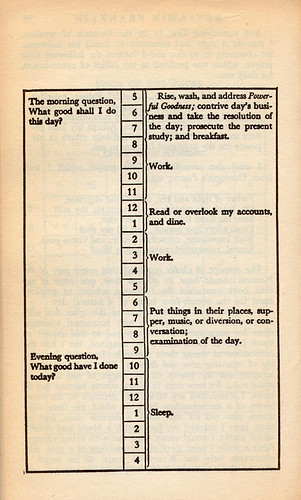
Benjamin Franklin's Daily Schedule

From one of the most productive people in American History (via Swiss Miss):

Benjamin Franklin's daily schedule

Sunday, March 13, 2011

Quote of the Day

Too true. From "Eliezer" on Hacker News:

World domination is such an ugly term. I prefer to call it world optimization.

Tuesday, March 08, 2011

A Sad Moment...

I heard about the assassination last week, but until it was brought to my attention by a friend, I didn't realize it had been a man I met (friend of a friend). I didn't know who Shahbaz Bhatti was at the time beyond being the Minister for Minorities in Pakistan, and the meeting itself was a bit rushed, but reading more I come to the realization that I met a great man and am reminded of what we take for granted (WashingtonPost):

American leverage in these matters is limited, but it is worth applying what we have - something the Obama administration, to this point, has not done. Its National Security Strategy avoids the topic. It did not appoint an ambassador at large for international religious freedom - a congressionally mandated position - until a year and a half after it took office. (The confirmation of that ambassador, by the way, is now held up by Republican Sen. Jim DeMint.) "This has not gotten," Clinton said at a recent hearing, "the level of attention and concern that it should. . . . I think we need to do much more to stand up for the rights of religious minorities."

This was precisely what Bhatti was doing - defending the rights of believers in every faith, not just his own. But the source of his courage in the cause of pluralism was clear: "These Taliban threaten me. But I want to share that I believe in Jesus Christ, who has given his own life for us. I know what is the meaning of [the] cross, and I am following the cross."

Which he followed all the way to the end.

Printing a Human Kidney

Another impressive TED talk (via Paul Kedrosky):

Monday, March 07, 2011

Cultural footnotes

Given that I love both Subway and McDonald's, this warms the cockles of my heart. There are no losers in this race. We're all winners for it. From the WSJ:

It's official: the Subway sandwich chain has surpassed McDonald's Corp. as the world's largest restaurant chain in terms of units.

At the end of last year, Subway had 33,749 restaurants world-wide, according to a Subway spokesman, compared to McDonald's 32,737. The burger giant disclosed its year-end store count in a Securities and Exchange Commission filing late last month.